Saturday, April 5, 2008

Zidane, Corporate Robot?: From this month's "So Foot"

SO, I’m here in France – enjoying a self-imposed writers retreat, and loading up on French football writing. I came across this provocative interview in the April issue of the glossy magazine, So Foot. It’s with Abdel Raouf Dafri, the scriptwriter for La Commune, a new series broadcast on Canal +. The interview was conducted by Simon Capelli Welter. It’s a fairly generic discussion of soccer & the disenfranchised – at the end, though, he makes some harsh statements about Zidane. I'd love to know more about this - I know Zidane presents himself apolitically, but Zidane gave Sarkozy his maillot (in 2006)?! That somehow hadn't made my radar screen. Say it ain't so Joe!

Anyway, I’m hoping the guys at So Foot don’t mind my unauthorized translation of the Dafri interview – it’s rocky – I may have taken some liberties, but I’m sure I’ve the basic points right.

SF: There’s something missing from La Commune, right? It’s about the banlieu, but there’s no football.

AD: Football is the least cinematic sport you can find. All football films are miserable flops. Football’s appeal is in the direct experience of emotion, it’s the suspense. In a film, the director shows you there is a good team, and a bad team – there’s no point. To make a story out of football, you have to look behind the scenes, at “how one makes a player”. I’d love to see a film with Cantona as a corrupt agent.

SF: Who would he represent?

AD: Tibéry – I mean Ribéry! I’d love to know how one makes a guy like Ribéry. A guy who comes from the streets. He grew up in Boulogne – really, a he’s a kid from the favelas.

SF: They say it’s like being an “immigré de l’interior” (roughly, a domestic immigrant - trans).

AD: Yes, that’s a lovely expression. You should check out Boulougne-sur-mer. I dare you to spend two weeks there. […They talk here about the relationship between regionalism & nationalism.] I’ve been [to places] where there are guys who don’t know the names of streets more two steps from their house. It’s crazy…You say to them – “Look – there are chances to get out, work [in other places] and they don’t want to go. They only want something two bus stops from their place, max. The reality in that region is grim. Economically, intellectually, in terms of artistic creation, it’s bleak.

SF: There’s just football.

AD: I have a theory: the cities that have some money have very mediocre football and in the poor cities, it’s a religion. [Hardly his theory alone! - trans] In Lens, the guys in the stadium are there for the love it. But, they don’t have anything else. In any case, I don’t really like stadiums, I don’t like crows and then…One night, I was DJing at Macumba (a club in the banlieu in Lille), we were asked to put the TF1 match on the club’s screen. I turned on the projector, and I saw some sort of massacre – I thought this isn’t the right channel. I switched channels, I couldn’t find the match, and I put the images of the slaughter back on. I went back to the music – funk, or something from that time. The images of the violence played on. It took us ten minutes before we realized that it was the right channel, and that the match had been interrupted by a fight. It was Heysel….

SF: That was Brussells, not to far from here….

AD: When they had World Cup in the US, we asked an American cop, the Dallas sheriff, what he thought of hooligans. “If they make a move, we’ll hang them by the collar like the wash.” [I think] There wasn’t a single incident. Hooligans know that if they get locked up in the US, it’ll be with gangs. And that’s no joke…. But in France, guys know that the cops are nothing [there’s that word “walou” again – trans]. During the World Cup in France, there was that cop killed by English hooligans in Lens [was he killed?? JD]. The problem was simple: the French cops looked at guys who looked like them – white hooligans — and they weren’t on their guard. A group of black guys would never have killed that cop. The cop would have pulled his gun. It’s usually the black supporters who see one of their own killed. Same in Heysel. The Belgian police really kept an eye on the Italians, because they’re dark – so they didn’t really put surveillance on the English. They just let them drink.

SF: What do you make of the whistling during La Marseillaise?

AD: It’s pathetic Those guys crack me up. They were born in France. I’m Maghreb (from North Africa), and at one time, I had to ask myself those questions. With these whistles come questions about French society. But we shouldn’t indulge in self-victimization! You have to get off your ass! Most of those guys are spending 150 euros on their sneakers – and they can’t buy a book for 20? Look, these guys from the hood, they make me look at things from a different angle. Today, you can’t get anywhere without an education. You think Barack Obama got where he is because he looks good in his Nikes? He went to Harvard! You have to teach, take care of yourself. And if the system doesn’t give you a chance, too bad – teach yourself. My parents were illiterate. I went to a technical school. In school, everybody came from the same background – the poorest. 90% were children of immigrants. From every direction, from the left and from the right, Arabs and Blacks are fucked. They go on about Rama Yade and Rachida Dati. You have to laugh. It’s like Condaleeza Rice – they say “she’s black”. No, she’s not black, she’s republican. Look at Rachida Dati, or Zidane - their power is about the present but not the future [une force sur le moment mais handicap pour la suite], it derives from the fact that they think of themselves only in terms of function and ambition. Really, we don’t know where they come from. Rachida Dati, she doesn't talk about her experiences as an Arab woman because she understands herself as a woman from the political right….Zidane – what has he done for other Africans? He became the world representative for Danone! It’s the brand speaking. Not him. In terms of being human – he doesn’t exist. Zidane – he’s Johnny Halliday! [I think this might be the most scandalous bit! - JD]

SF: You have to be apolitical and compliant in order to have universal appeal.

AD: You don’t give your shirt to Sarkozy when you are Zinedine Zidane. With Brice Hortefeux as the minister of immigration, his family would never have gotten into France, and we’d never have had Zidane. As an Arab, he has to ask himself some questions! His parents come here, speak French, work, build a respectable family, teach their kids values. Their son becomes the greatest player in the world and what does this son do when he retires? He gets on the payroll for Danone?....I’d love see for the record his political position.

SF: Thuram [adoring sigh from me - JD] isn’t afraid of positioning himself.

AD: He’s doing the right thing, even if it's sometimes awkward. Karembeu too, when he addresses his roots as a Kanak. I have to give respect to the guy who doesn’t forget where he’s from. I can’t say where Zidane comes from. For all I know he’s a digital hallucination. You don’t know if he’s even real, you don’t know what he thinks about. Except how to appeal to as many as possible. That’s not how it works. You can’t appeal to everybody – you choose a camp. We are staring down some huge problems in this world, and you have to take a position on them. With these guys who come to have so much influence and then don’t do anything with it, you can be sure you know why they are there: “I just want the dough, I don’t want any trouble, so I’m not going to rock the boat.”

Note: I have my own take on this interview - on the contradictory threads in his rambling about how one needs to pull oneself up by one's bootstraps et al. But I thought these comments were great to share with those outside France, where it may come as a surprise that Zidane as seen as super vanilla.

Monday, March 31, 2008

11th? Really?: Bad Reporting in the UK on American Fútbol


This weekend, the Guardian published a bit of misinformation. Laurence Donegan's somewhat obvious bit of punditry about how the Galaxy's second season with Beckham faces the serious challenge of 'Now What?' turns on a greatly exaggerated portrait of public disinterest in soccer in the US. Donegan is the Guardian's golf correspondent, and, according to his by-line, he filed this article apparently from 'Los Angeles' but, I'm guessing that was probably more rightly 'from his Los Angeles hotel room and wi-fi connection'.

Can I just say how tired I am of reading articles in which UK journalists recycle their own common-sense ideas about football in the US? Almost every single one of these articles is written by a British journalist, based in the UK, who can't see past their own television set.

Like many American readers, I was really irritated by the following:

It is a baking hot morning in Carson, California, and David Beckham is still making his way back from Paris after his 100th appearance in an England shirt, leaving his Galaxy team-mates to get on with the business at hand - preparing for their opening fixture of the 2008 season, against the Colorado Rapids in Denver later today, and defending the marriage between football's most famous player and the United States' 11th most popular spectator sport, Major League Soccer.

Now, setting aside all that we might have to say about the Galaxy's grim defeat (4-0!), I want to draw your attention to an offensive bit of rhetorical manipulation at the paragraph's conclusion - meant to maintain the delusion that Americans don't watch football, and that the only people who play it are women (who don't matter in the eyes of 95% of sports editors).

11th most popular sport? First off - Major League Soccer isn't a sport. It's a league. What Donegan must mean is that MLS broadcasts are the 11th most watched sports league of, I'm guessing, English-language major network broadcasts. So, that's NFL, Major League Baseball - American and National League, NBA, NCAA basketball, NASCAR, NHL Hockey, etc. Oh, yeah - and USPGA - meaning, golf.

There are other bits of knee-jerk journalism in there - about how not all the seats at Carson are sold, for instance. A person with even the slightest investment in writing about the development of the sport might look more closely at the ambivalent relationship between the MLS, team owners, and the actual fanbase for the sport - and see the stadium's location as emblematic of these conflicts. If that stadium were three times as large and downtown, you'd never be able to get tickets [see, for example, these stories about fútbol matches staged at the LA Coliseum].

I could go on and on about this. But the article is just lame and totally predictable anglo/euro-centric bull and the Guardian should be ashamed of itself for publishing such a lazy bit of writing.

For the record, by many counters, soccer is the 4th most watched - tied with Hockey (some Mexican legaue games have drawn greater numbers for their broadcasts than have the Stanley Cup finals). But who is counting, how, and what they are counting varies.

If The Guardian wants some smart opining about Beckham's career with the Galaxy, and some solid griping about MLS and its half-baked ideas about how to grow the market in the US, well - why not pay someone who actually follows this shit - and can tell you about how the Galaxy's trouble began well before Beckham's arrival (Donegan's article also makes it sound like Galaxy's miserable season last year came a surprise).

How about some writing about the really interesting developments in the semi-pro circuit - like The Offside's great article about the NPSL?

Postscript: I edit the 'event review' section of the academic journal American Quarterly. Noted American Studies scholar and NYU Professor Andrew Ross wrote a great piece for us on Beckham's debut - 'The Ballad of Posh and Becks'. Academicians reading this can find it on Project Muse and in your university library.

Tuesday, March 11, 2008

I (Heart) Referees

We do a lot of complaining about ref's - about the ref who was surely stoned, about the ref with byzantine ideas about offside, about refs who police according not to football rules, but (in women's games) according to how he thinks ladies should behave. And then there are the refs who've been bought off, who extend the first or second half beyond regulation time for just as long as it takes you to lose the lead you'd carved out, or the refs who are too easily persuaded by theatrics. One sees a fair amount of crazy refereeing in the amateur leagues. (Pictured here, ref Kim Milton Neilson - famous for sending Becks off during a WC match with Argentina - about to eject Rooney from a 2005 Champions League game for this snarky clap.)

For all their limits, though, I'd rather have the odd crazy ref, than take the field without one.

The most complicated and dangerous game I play is a weekend kickabout - not only because it's mixed football, but because a lot of the players in that game have never been refereed and so don't have even that "internal ref" which experienced players use to curb their instincts. I must admit that when I started playing in this game I'd never played football, and started by playing defense. I would pick a player (usually this poor guy Justin, because he posed the biggest challenge and was playfully smug), and I would mark him for the whole game. I used to love this - until I learned by playing in another setting that I'd been fouling the poor guy for nearly a year. As an NCAA basketball fan, my idea of defense was borrowed from watching that sport. I was not only not very effective - I was also somewhat dangerous. It took me ages to learn that running full speed at someone with the ball - with little plan other than intimidation, or interruption of their movement - was a bad idea. I wasn't good enough to have much control over myself, never mind the ball - and a player with any experience whatsoever will, when presented with such a challenge simply pass the ball to someone else. A less experienced player might tough out the challenge, but usually the result there is some sort of collision - and the sort of contact that ought to bring a whistle if not a card.

I am to this day very grateful to my soccer-pal Ben, who took the time to explain that effective defense is more about containment, patience, persistence and good decision making, and to Mia Hamm's book Go For The Goal - a great introduction to the basic principles of the game.

In our 'friendly' game, we have players everybody stays clear of (with no ref to control them, you either back off or risk injury). I've been pulled by my arms by one of these folks - who then yelled at me (for protecting the ball in a legal manner - as an inexperienced player she didn't understand that if she was pushing at me from behind, I could shield the ball with my body and push backwards to make space). I found myself so upset by her insults that I had trouble playing afterwards, largely because no one else was willing to intervene to point out to her that her behavior (deliberately grabbing and yanking a player off the ball by the arms) was basically a red card foul.

The problem wasn't so much the foul itself, it was the feeling of exposure that it produced. With no referee - and no culture of self-refereeing - individual players are left to sort it out between themselves, to put up with or confront bullying, and to make their own decisions about how much injury they are willing to risk.

Very few people are willing to mediate such conflicts. Most people, in my experience, will put up with players who’ve broken bones of other players, or put up – week after week — with players who tease and push less confident or aggressive players to leave the game. Most don’t have the mettle to confront the problems behind such behavior and find a way to correct it, and protect everyone who wants to play. Sadly, my experience has been that in general, people are conflict-averse, and have little sense of collective responsibility towards each other. (Pictured here, Pierliugi Collina - largely thought of as one of the best refs to take the field - now retired.)

The referee turns a free-for-all into a game by taking the responsibility of setting limits and making sure people respect them. They – and the principles we internalize by playing with them - are the ones who make the game fair, and fun.

The referee also gives meaning to the outrageous act: Zidane's head butt would not have taken on the dimensions of a Greek Tragedy if it hadn't produced that red card (which became its own drama in and of itself).

Refs give us a huge gift by taking up the whistle – because in doing so, they give us a space in which we are freed from our worst instincts, and in which we gain access to something that is increasingly rare in our daily lives – fair play. I wish I could take one to work.

Monday, March 3, 2008

Residual Image: Tackling the Tackle

For the past couple weeks, the tackle that broke Eduardo de Silva's leg (and then some) has been on the minds of not only Arsenal fans, but all who follow the English game.

One of the most interesting observations regarding Martin Taylor's tackle comes from International Herald Tribune columnist Robert Hughes, in his article "A Shocking Tackle Raises Questions of Intent". He writes:
It is instructive to recall that in his younger days, when Taylor was with Blackburn Rovers, his then team manager, Graeme Souness, said of him: "For Tiny, being physical is an area where he is short. With a body like he has, I want him to be a bully. But he is too nice - he is perfect son-in-law material, but I don't want a team of son-in-laws!"


Those comments seem to encompass the ethos of the British approach to the sport it gave to the world. The emphasis on physical aggression comes at a cost of ball skills, and is a reason why England is not going to the European championships. It was eliminated by Croatia's quality, and by Eduardo's goals.

Hughes suggests that we might see this bad tackle - between a big English player and a lithe, quick Brazilian player - as an image which captures a larger problem, one with no easy solution. This clash of style is behind the more recent flurry of remarks regarding Man U's perspectives on refereeing.

Cristiano Ronaldo's complaints that he can't play his game because he's afraid of getting hurt may sound like the whining of a primadonna. And Fergie's complaints that the ref's aren't protecting his star player lose all credibility when made on the heals of the loss to Portsmouth. Wenger's uncharacteristic diatribe about the viciousness of the tackle was eventually retracted.

The fear of injury, however, is a very real and even defining part of being a competitive athlete in any sport, especially at this level. It is also a big part of getting older. CR is 23, Wenger's team is famously youthful - one has to wonder if the unfolding stories of outrage and upset aren't in part about maturing, and confronting the consequences of one's place in a football system that is notoriously brutal. This isn't to diminish the seriousness of their critiques of the brutality of the English game. CR is right to think perhaps this isn't the league for him - not because he's a wimp, but because he has a right to want to play as deep into his 30s as he can.

Hughes suggests in his article that Taylor's mistiming was not a reflection of a lack of skill, but a reflection of Eduardo's unusual speed and talent. By the time the tackle is executed, Eduardo isn't where you expect him to be - the confrontation of this one type of player (fast, ingenious, unpredictable) with this other type of player (physically intimidating, militarized) tears the game apart. If CR wants to be free from anxiety about taking physical challenges from larger players, he might do better in a different setting. That said, what league would free one of the top strikers alive from physically aggressive challenges eludes me.

This is one of football's biggest challenges at all levels - we all prefer watching players with magical footwork. But when we face opponents with those skills, we want to see those players shut down - with a tight and fearless back line. Consider the sometimes dramatic differences in the physical presence of players, and the strange vulnerability of the football player (unarmored, often running at full speed, flying, even) and you have a couple of the main ingredients for the thrill of the game. A great tackle is a thrilling thing to watch - when executed well, it is a sign of respect. (e.g. Japan's Hiromi Ikeda trying to fight off Germany - the eventual World Cup Champions - I am not sure Ikeda got the ball from her opponent here, but the image is great!) Being on the receiving end of a good tackle makes you raise your game. Being on the receiving end of a bad tackle makes you wonder if it's worth it.

Great defense is a relatively unheralded art (as in this attack from Man U's Wes Brown, on Sunderland's Kenwyne Jones - I think I've ID'd them right). Try a google image search for "tackle", "great tackle", or "slide tackle" in soccer and you'll find more images of bad tackles, violent tackles, and hair-raising injuries than you will of hard, effective, smart attacks on the ball. For example - "best soccer goals" yields 269 pages of 20 images of great goals; "best soccer tackles" yields no pages at all. Youtube is a bit better, thanks to the likes of "Chris-Ronaldo7" who puts a few of his fave's to Green Day (I think). Even here, though, youtube's "related videos" bar is basically a casualty list. It's unfortunate - a great goal makes for a great photo. A great tackle, though, is much less interesting to the lazy eyes of the mass media than a brutal assault.


A bad tackle breaks the spell cast over the beautiful game to reveal the fragility of everyone on the field. Great distress was written across the faces of all of the players and fans that day. The fear in everyone's hearts was for more than the safety of player - it was, and is, fear for the integrity and health of the game itself. Seeing a brilliant player like Eduardo brought down for what looked like forever (and is perhaps 'only' a year) puts a good deal of anxiety in everyone's hearts. Nobody wants to see injuries of that magnitude become routine.

But do we have the heart to really explore the ugly side of football culture in the UK and Europe? Like the mass impulse to brutality which underwrites ugly fan chants? Like the demand that one win at all costs? Like what it means to treat the game more like a business than an art?

Ultimately, I suppose it is the referees who must keep the horrifying image of that tackle in their heads. But it shouldn't be only up to them. If an event like this doesn't force the people running and watching the game to question where it's going, well, then we've all really gone off the rails.

Wednesday, February 13, 2008

FA Apologizes for its Sexism and Homophobia? Really?

This past weekend, fans of the women's game gathered in Regents Park to honor Lily Parr, the first woman inducted to the National Football Museum Hall of Fame. Parr was an amazing character, from an incredible time in the history of women's football in the U.K. Renown for her athleticism and skill, she was a celebrity in the late teens and twenties, and was directly impacted by the 1921 FA ban that barred women from FA pitches and forbid FA members from refereeing or working as linesmen during women's games.

The Guardian reported on an FA statement issued over the weekend in relation to the Parr Trophy match - which was not, as far as I can tell, sponsored by the FA in any way. The newspaper story, "FA Apologies for 1921 Ban", offers no direct quotes from an FA statement, raising the question: Was it really an apology?

The Lily Parr Exhibition Trophy Match
was part of Gay & Lesbian History Month - it was played between the London Lesbian Kickabouts and Arc-En-Ciel, a Parisian lesbian football team - recreating in spirit the first international women's game played between England and France. The fact that this celebration of Parr was a part of Lesbian & Gay History month - and that the two teams which played are lesbian feminist teams was not mentioned in Tony Leighton's telegraphic story (was anyone from The Guardian's staff there?). I suppose we should be grateful there was any mention of that match, of Lily Parr, and of the rest of action in the women's game this week in the four paragraph story. But is it really journalism if it's reporting final scores, and recycling press releases?

The Kickabouts posted the following on their website:

"Lucy Faulkner, Equality Manager at The Football Association said 'In 1921 The FA requested that clubs belonging to the Association should refuse the use of their grounds for matches played by women with the purpose of raising charitable funds. Furthermore, they stated that 'the game of football is quite unsuitable for females and ought not to be encouraged'.

The damage this did to the women's game is hard to calculate but I am confident that with the support and investment of The FA in women's football in 2008, the sport will continue to go from strength to strength.'" There's another statement on the Kickabout site from Trevor Brooking, director of development at the FA about the growing strength of the women's game.

The Kickabouts quite rightly list this not as an "apology", but as a "response". A response from the Equality Manager is not an apology from the FA Board.

Maybe something went down at that game that has yet to surface in the blogs, like:

"FA Board members attend LGBT celebration of legendary athlete Lily Parr, and apologize for the sexism and homophobia that continue to dominate football culture. Vow to change their own attitudes, to give the FA's full support to its women players - and kick homophobia out of the men's game while they are at it."

ps: For more about Parr, see Barbara Jacobs's book, The Dick, Kerr Ladies.

Friday, February 8, 2008

A Tree Falls in a Forest: Watching Women's Football

Women's football faces serious challenges - like the commonly held opinion that it's boring.

I've heard this opinion expressed not only by men - by men who love football so much they'll watch the game in any form and can opine about the most minute aspects of the game and all of its institutional intrigue - but by women who are also ardent fans of the game, and even play themselves. Some of my own teammates have said as much.

These nay sayers will tell you the pace is slower, the play less spectacular - that the women's game just isn't exciting to watch because women athletes aren't as explosive as men, and the games aren't that competitive. Now, as is true of most biased thinking, these opinions are grotesque distortions of a few truths (the strongest women aren't as strong as the strongest men, or as fast, and in even those countries with competitive semi-pro leagues, the women's game is unevenly developed - witness Arsenal Ladies' dominance in the UK, Lyon in France, Umea in Sweden).

But the fact of the matter is, if women's football seems boring to these people, it isn't because women aren't men, or because one team is better than the rest. Almost every person who has said this to me has also confessed that they have never seen a game - not even on television.

I come from a country that loves NASCAR. Half my male relatives here in London spend their weekends watching golf, and the rest of the week talking about it. These sports are, in my view, inherently boring. So is the Tour de France. And the New York Marathon. Cricket, anyone? Who wants to watch that? Turns out, lots of people do.

The Chicago Bulls' dominance didn't kill basketball. The fact that Michael Jordan was just plain better than everyone else didn't make the game boring. Everybody either loves the Yankees, or they hate them - and that makes us love baseball even more.

I love going to the Staples Center to watch The Clippers lose - again. Sure it's fun to watch the game - but that fun is amplified a thousand times over by being a part of the crowd. This is why very few people go to these things by themselves - I went solo to a Galaxy game and boy did I feel weird, like the kid who sits by herself at the school cafeteria. Until I was "adopted" by the Chicana lady sitting behind me - the two of us spent half the game on our feet offering - at a very high volume - to play defense.

The pleasure of watching minor league baseball is in the ambiance in the stadium - who cares if the Durham Bulls win or lose, or by how much? I mean, one cares - we route for them, but we show our love by being there - whether they are having a winning season or not. We go to such things because we love listening to our neighbors crunch statistics, scream at the umpire, or work through their philosophical treatise on the confrontation between a particular pitcher and the man at bat.

If these things weren't true, we'd all watch sports on t.v. and teams would play for the camera alone.

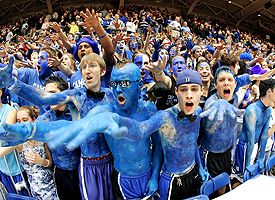
Duke students sleep in tents for weeks because they don't want to watch the Chapel Hill game in their dorm room - they want to watch the game in Cameron Stadium, squeezed into the stands with everyone they know. And scream their heads off.

And there is nothing like the euphoria of watching a great goal with a stadium full of people, having your shout both drowned out and absorbed into that of thousands. I can hear the oceanic noise of Arsenal fans from my flat - it's the best music on earth.

The pleasure and importance of being there is arguably most intense for the football fan. I remember arriving to a Galaxy game a few minutes late (I'd driven directly from work - argh, the 91!). I had to park miles away from the stadium, and as I hurried across the gigantic parking lot I could hear the crowd - oohhing, ahhing in waves as the ball advanced, was repelled, as an attack took shape and was dissolved. The noise was continuous, rhythmic - my heart was in my throat just listening to this. I don't know a sport that has this sound. Basketball, baseball, American football, rugby all stop and start. As exciting as it is to see any of those games live, you don't get that rush of holding your breath for 45 minutes, and then doing it again for the second half.

Watching a baseball game has the pleasures of a day out with your friends. Watching a futbol match is like a crazy one night stand with a sex fiend. There's no rest, no pause for reflection - it's like jumping off a very, very tall cliff. Twice. This is why football fans are so nuts. And sometimes dangerous. Think: Fatal Attraction x 40,000.

The women's game has as much capacity for producing this pleasure: the fabled 1999 world cup final more than proved this. That game was played before an audience of 90,000 in the stadium, and 40 million television viewers in the U.S. That's the most watched soccer game in U.S. history.

Women are quick, strong, and explosive on the pitch. Women athletes are arguably *more* competitive than men - we have way more to prove. Women twenty years ago and today play not only for themselves, but for future generations. And as more women from different football cultures play we are seeing all of the things that make the game fun to watch brought onto the pitch: confrontations between sides distinguished by great footwork, flare, and style and sides known for militaristic precision and strength (Brazil/Germany); historical rivalries between teams that hate each other (US/Norway - the image below is from an Olympic semi-final match, and that'd be a Norwegian player here, with a fistful of Mia's shirt).

Marta's mischievous samba before a frustrated American defender is burned into my brain: I've never seen a more flagrant or effective taunt in any sport.

But who cares about all that if there's no one else there watching it? Who do you have to talk to about it after the game? THIS is why people think women's football is boring. Most sports fans want to belong to a mass audience, be a part of the crowd.

The media should be more committed to combating the problem. Aside from the odd blog or two, and the occasional minute story about women's league games, there is very little attention paid to the sport - especially when you consider how very many people play it.

Walk into the sports section of any bookstore and you might be amazed at how many books there are fly fishing. Or sailing. It amazes me. But of course it doesn't surprise fans of those sports.

But walk into a bookstore in the UK, and try to find just one book about women's football - and I don't mean the one book of drills out there (which seems to be a standard drill book, in which some clever publisher just substituted the feminine pronoun & put in illustrations of girl players). In fact, try to find a book about any women's sports or about any women athletes. Out of the six hundred sports titles at your local Borders, I defy you to find 10 about women athletes in any sport. (They'll have Paula Radcliff's autobiography, but usually that's it - not even a book about Billy Jean King or Martina Navratilova.) These books are out there. Mia Hamm's Go For the Goal, for example, was a best seller in the US - and there are autobiographies of other US players, as well as two social histories of women's football written by the UK academic Jean Williams. There's a whole magazine about women's football (Fair Game) - but who carries it?

Want to make money? Tell Nike and Adidas to stock women's football boots, and long pants for playing in cold weather. And shirts for the women's teams while they're at it. Broadcast women's games, and advertise stuff like that, just as is done for the men.

Until the media commits to the story, women's football is the falling tree in the forest no one hears. Until networks broadcast women's games regularly, newspapers cover league play more comprehensively, until the story becomes about something more than how miserably women's football is treated - and becomes instead a story about great upsets, struggling teams who don't play to their potential, and improbable sides that play well above theirs, about lousy managers and magicians - until then nobody aside from the most dedicated will pay any attention.

It's up to us of course to change things: To march up to the newstand and ask for Fair Game, to ask the bookstore manager to carry more titles in sports about women athletes. To write in to newspapers asking them to expand their coverage. And to get ourselves to the games and show our love in person.

The FA doesn't make the last bit easy: nationwide, amateur women's teams in England get the leftover slot when it comes to pitches. We play on Sunday afternoon - on the same day and at the same time as women's Premiership teams.

Well - until that gets straightened out, I'll do my best to make the odd weeknight match. And on Sundays, you'll find me routing for Arsenal ladies, but playing on the Hackney Marshes, and wondering why the fuck no store in England carries a Marta Umea shirt.

Friday, February 1, 2008

The Battle Hymn of White Hart Lane

This is that unusual topic which allows me to indulge my passion for football, and, well, the passion that got me my day job teaching 19th century American literature.

If you are lucky enough to visit White Hart Lane on match day, you might hear the Tottenham fans chant "Glory, Glory Tottenham Hotspur", to the tune of the song popularly known as "The Battle Hymn of the Republic".

This is a patriotic American song - the sort of thing one hears sing over a loudspeaker at a fireworks display on July 4th, or belted out by a High School marching band around Thanksgiving. The Mormon Tabernacle Choir, for example, does a nice, sober version of this patriotic melody.

It was weird to hear Spurs fans rooting on their team with the music from this popular but staid American anthem. Almost as weird (and weirdly moving) as hearing Liverpool fans sing "You'll Never Walk Alone" - a song from the Rogers & Hammerstein musical Carousel - popularized by singers like Anita Bryant, Doris Day and Judy Garland (whose version is used here to animate a photomontage celebrating the fellowship of the ring!) - and let's not forget Jordan Sparks, who belted it out for American Idol. You have to understand: for those of us raised outside the UK, there's something fundamentally incongruous about the idea of Liverpool fans knowing the words to a song from Carousel.

Inspired by a song she'd heard Union soldiers sing, Julia Ward Howe wrote the lyrics for "The Battle Hymn of the Republic" in 1861. Many of you will know at least the first two lines of the opening stanza:

Mine eyes have seen the glory
Of the coming of the Lord;
He is trampling out the vintage
Where the grapes of wrath are stored;
He hath loosed the fateful lightning
Of His terrible swift sword;
His truth is marching on.

As loaded with images of God's wrath as it is, this is a neutral, 'cleaned' up version of the original song sung by Union soldiers marching into battle during the Civil War. Then it was known as "John Brown's Body" (also known as "John Brown's Song"). (PBS has a great web page with audio clips & text about its origin, and University of Virginia professor Franny Nudelman has written the book about this stuff.)

There are different versions of the song lyrics - but here's a simple one that gives you a sense of its peculiar, and peculiarly moving images:

John Brown's body lies a-mouldering in the grave,
But his soul goes marching on.
Chorus:
Glory, glory, hallelujah,
His soul goes marching on.
He's gone to be a soldier in the Army of the Lord,
His soul goes marching on.
Chorus:
John Brown's knapsack is strapped upon his back,
His soul goes marching on.
Chorus:
John Brown died that the slaves might be free,
His soul goes marching on.
Chorus:
The stars above in Heaven now are looking kindly down,
His soul goes marching on

Other versions have more complex lyrics - like:

"He captured Harper's Ferry with his nineteen men so true
He frightened old Virginia till she trembled through and through
They hung him for a traitor, themselves the traitor crew
His soul is marching on."

Or,

"Oh, soldiers of freedom, then strike while strike you may
The deathblow of oppression in a better time and way;
For the dawn of old John Brown was brightened into day,
And his truth is marching on."

The song became, as evidenced by the above lyrics, a popular vehicle for celebrating the story John Brown the abolitionist - a white man who was so opposed to slavery that he took up arms and led a raid on Harper's Ferry, a munitions facility - an arsenal, in fact. (No kidding!) His aim was to set an example with a successful raid that would lead to massive internal rebellion against the slave holding governments of the southern states. The raid failed, and John Brown and his comrades were hanged by the US government.

Amazing, then, that only a few years later soldiers fighting "to preserve the union" would honor a man executed by the government for trying to start a civil war. John Brown's story is one of the most fascinating in American history - it is, however, not often taught in schools. One can imagine why - because in telling that story, we find ourselves confronted by ugly truths about how violently the United States committed itself to slavery, and for how long. From this point in history, John Brown's raid looks like the right thing to do: But it raises the question as to why more people didn't throw their lot in with those held in bondage.

Today, he is largely remembered as a religious fanatic.

Anyway - it is without a doubt one of the all time great political songs - right up there with "Strange Fruit". Not in melodic beauty - JBB is mind numbing, relentlessly repetitive - thus a marching song well suited to Spurs fans who (and you know I love you) can't seem to do better than sing "Come On You Spurs" or "If You Hate Arsenal, Stand Up" - over and over again. "John Brown's Body" is up there with "Strange Fruit" as one of those songs that changed the world. It is a song with a crazy history - and it is a song about crazy history. Once you know who John Brown was, why he fought and why he was hanged, when you hear that music you can't but feel a certain crazy determination in your bones to just get out there and make something happen. Audere Est Facere indeed.

So, in the end, "John Brown's Body" has a meaning very similar to "You'll Never Walk Alone" - it means something like: Everyone else in the living world might think you are crazy - but we'll follow you even if it means following you to our graves, knowing that we have righteousness on our side as we do so. Especially if you are taking on Arsenal.


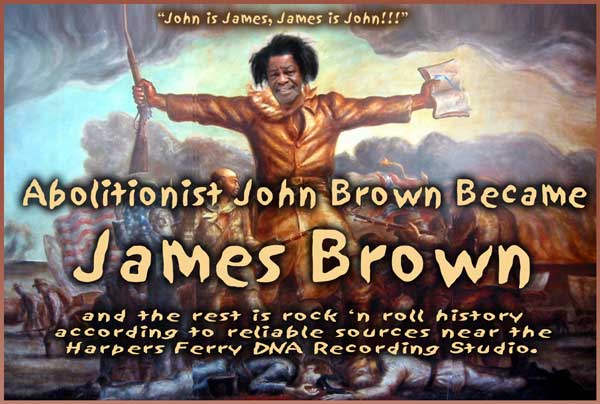
(note: John Steuart Curry's mural celebrating JB's role in the anti-slavery fight is the on the right - that'd be Brown with the Bible in one hand, gun in the other. And left: a more recent riff that gives you some sense of what a knot in Americana we have in Mr. Brown.)

Wednesday, January 23, 2008

Men Play, Women Talk?

I've been browsing youtube & google video for soccer commercials featuring women - esp those featuring freestyle or just play. I noticed that the few Nike ads featuring women (USNWT) almost never show actual play. This is curious - given the much loved the Nike Joga Bonito ads - which, along with fifastreet ads, form their own viral video kingdom. There isn't much talking in *those* ads - mostly just awesome footwork.

Adidas did a little better with a 2003 Women's World Cup ad (pictured above) that presented a distinctly American nightmare of the Chinese national team (actually, some players & lots of stunt women) doing acrobatic tricks with the ball in unison (with no apparent awareness of the stereotypes invoked). There was an old Gatorade series animated by a searing goal or two from Mia Hamm - way back in 2000? (I'm guessing.) Brandi Chastain did something between a commercial and personal profile for Tailwind (a Nike line), in which we watch her juggle while she's talking (part of a series profiling women on the USNWT). Chastain's ad left me wanting to see more - she was so casual, in that way people with a great sense of touch can be - keeping the ball up, moving it from foot to shoulder to knee seems to take no concentration at all. Like talking with your hands, except you are using your whole body, and a ball.

None of the more recent Nike ads have much actual soccer in them. They are talky, defensive, full of cute jokes about "the greatest team you've never heard of", that do very little to demonstrate why anyone should be hearing about them. (See! They have a sense of humor! Totally not threatening!) It's funny how sexism can be the topic of an ad campaign that nevertheless goes on to repeat some of the problems in mass media coverage of women's soccer (focus on everything but the actual physical talent of the athletes).


Fans do a better job - because they are splicing together their homages from game footage. There's an impressive German montage of greatest goals by women's players (which goes back to the early 90s). There isn't a whole lot out there in the virtual ocean by way of Marta footage, but there is nevertheless a handful of great compilations, including some of her playing for Umea. Check out this one - Marta highlights set to death metal. I love soccer fans.


I have to say - even though it features no play, no footwork, I was really pleased to stumble on the following - an old ad featuring Julie Foudy getting a check up.


Hilarious!

Saturday, January 19, 2008

David Beckham: Lesbian Icon

David Beckham is a lesbian icon.

That Beckham's charms are appreciated by straight women and gay men is a given. Beckham himself says he's "honored to be a gay icon", and, as the original metrosexual he has never been afraid of flirting with the edges of officially sanctioned straight masculinity - sarong, painted toe nails, ballet slippers, etc. His appearance in an Armani underwear ad is only the most recent image advertising his willingness to appear as sex object to anyone who fancies the idea.

But lesbian icon?

I stumbled onto this subject playing football with a great group of gals on a self-described lesbian feminist team. First time I showed up for training, I wore my Beckham Galaxy shirt - I wear it here with a sense of humor, understanding that people in London generally think Beckham's move to Los Angeles was crazy. As I took the field, I saw another gal also wearing a Galaxy shirt, number 23. It turns out that a lot of the women on the team really like Beckham - and don't hesitate to say that they are fans. I found that in this crowd I didn't need to pretend I was wearing that shirt with irony. My appreciation of Beckham is, to be honest, quite sincere - and is nearly enough to make a Galaxy fan of me.

In the locker room last week (we won, pretty much dominating the whole game, which was nevertheless kindof a slog on the Hackney Marshes), I floated this observation - that Beckham is something of a lesbian icon - and my teammates chimed in with a chorus of support for the idea.

He's of course loved by queer women for the same reasons he's loved by many football fans - for the kind of footballer he is. He's hard working, very sincere about the game, and he's capable of animating a team not through a lust for personal glory, but by passionately taking on the less glamorous work that happens in front of the back four: distribution, tackling, set plays, assists. He's the kind of player that makes other players look great and takes pleasure in this.

J.D. Samson
But he also "works" for queer women because the kind of masculinity he models is one he shares with some of our most compellingly queer lesbian icons (e.g. Le Tigre's J.D. Samson, pictured left). Beckham often appears boyish, openly sexual, and androgynous - and then there's his physical type - not beefy and lunk-headed (like Rooney) but lean, with fine features that always seem slightly at odds (in a tremendously sexy way) with his hard-bodied image. Even his reticence, his strange combination of self-consciousness and self-awareness has a queer resonance (that shyness can precipitate global stardom was well born out by Andy Warhol). Some women want to have him, some want to be him. And some of us want a little of both.

Beckham has what I like to call "Chachi charm" - the trans charm of boys who look like girls who look like boys (or girls who look like boys who look like girls). The reference is to Scott Baio's character Chachi, of the 70s t.v. program Happy Days - and the category includes, for me, those boys I had crushes on when I was a kid, like Jackie Earle Haley. He played the archetypal "burn-out" "Moocher" in 1979's Breaking Away, and the motorcycle-riding pre-pubescent proto 'playa' "Kelley Leak" of 1976's The Bad News Bears - the latter also notable, of course, for Tatum O'Neal's turn as the ultimate 70s tomboy with the vocabulary of a 1940s sailor. [FYI: Tammy Rae Carland took on this constellation of queer stars (from Carter and O'Neal to young Jody Foster) in her 'zine "I (heart) Amy Carter" (included in the anthology Girls Guide to Taking Over the World). ]

That the charm of the adolescent gender-bender has stayed with Becks well into his adulthood is a minor miracle - most men who start out with it lose it by their late 20s (note the disastrous late adulthood of Scott Baio himself). With Becks, one might say it's gotten rougher around the edges - much in the same way that it does when our androgyne sisters jump the fence and go full blown F-2-M.

Women on this planet of queer masculinity might include Daniela Sea, of L Word fame. She has this boyish charm in spades. Or, let's look at the more notorious model Jenny Shimizu. Shimizu is a particularly good point of reference for the sort of planetary pull such women exert - and which they direct more specifically at high-femme/ drive-you-crazy women like her ex, Angelina Jolie, or, the less famous but no less notorious genius Gwen Turner - Queer Hollywood's Dorothy Parker.

The truly crazy connection here: Beckham's infamous ex-lover Rebecca Loos has not only gone on record as bisexual - she married Shimizu in 2005 for a Logo TV program called Power Lesbian UK. Check out their Diva magazine interview.

Beckham's partnership with Posh - puzzling to so many - mystifies me not at all. One of the reasons he is so often pilloried by male journalists & intellectuals is this relationship: they can't stand that Beckham lets Victoria dress him, paint his toenails, that he's tried on her underwear, and, basically, lets her "top" him a thousand ways to Sunday, and, worse, that he's proud of it, too. I've found myself defending Becks to the most liberal of men - to leftie academic metrosexuals who prefer George Best to Becks, seeing in the latter a betrayal of the masculine ideals of the former.

I've never taken Posh & Becks more sexual photographs (in which he's often pictured dominating her, as in the recent W spread) to mean much about what happens between them privately - her penchant for leather, vinyl, lace-up, corsets, and lethal stillettos says it all. She's a high femme top, surely. And that sort - the ones who want the bling, like their men to light their cigarettes, open doors for them, to buy them lingerie and expensive handbags - these are the women old fashioned boy butches seem to adore.

And, finally, by way of conclusion, a gesture towards a queer reading of Posh and Becks: That Armani underwear photo has prompted global speculation: Is it real? Is that really his? Posh, pictured here wearing a very leather daddy hat, has also been at the end of that question (are those really hers?). She gave a great interview about the ad, and gushed about loving seeing
her husband's penis "25 feet tall" on a billboard, and has been the single greatest engine for publicity supporting the mythology of Becks' package (check out this old Ali G. interview with the two of them). The pair are so over the top, so playful about themselves, they deliberately tickle our curiosity about the line between the natural and the artificial - Posh makes a more than passable drag subject, and Becks has got to be the model for kings out there. I don't know anything about Australian drag king Jonnie Swift (pictured here in the dressing room getting ready with Sexy Galexy for the 2005 Sydney LGBT Mardis Gras) but he looks to me like Beckham's gay brother.

By way of an afterthought: Check out this great take from youtuber "Beaner LaRue": "Posh" explaining that the Armani-clad bulge really really is "100% his little Beckham":

Saturday, January 12, 2008

The Interior Life of the Substitute

I watched the Women’s World Cup final with my aunt in her living room. (Pictured here, Brazil's Christiane fighting off Germany's Linda Bresonik.) I watched the semifinal match between Brazil & USA in a sports bar in France. . I caught the televised second half of the 1999 final in Pasadena, but I don’t know where I was, or how I happened to catch it. I do remember that I kept switching channels, because the tension was too much - scoreless, the game famously went to penalty kicks, and the tension of watching that was excruciating! Watching the 2007 games was qualitatively different – because in between 1999 & 2007 I started playing.

The experience of watching soccer on television is much more intense now that I play. When I watch now, I have very mixed feelings – I get caught up in the drama of the match, of course, but I also wish deeply that I could play like the people on the screen. And I want to be playing at that moment.

That desire can be so intense that my body begins to very nearly act like it’s playing – I’m like a sleeping dog dreaming about chasing rabbits. My feet are restless, my legs want to run - the most powerful sensation of watching football is this feeling of being physically hailed by the game. This is even worse at a live match – if I’m sitting near the pitch, it’s all I can do to restrain myself from jumping onto it.

This experience is new to me. I suppose this is how lots of people who play must feel about watching – enthralled, caught up in it, there, but hyper aware too that they are not there. The embodied memory of playing is a complicated gift: It gives you both the ability to feel what it feels like to play (and thereby get even more involve with the action), and an awareness of the real difference between you and the those on the pitch.

I am ashamed to admit that I really thought that watching sports was a relatively passive thing – but watching a soccer game is a lot like watching a really good suspense film, or reading an engrossing novel. Time seems to stand still and race by, you forget you are where you are, you are instead projected outwards with your interest – you are in the stands, on your couch, but somehow not. Somehow, you are there. Your heart races, palms sweat – watching a great game is almost unbearably exciting. But behind all of that excitement is a bittersweet sadness about that gap between us and them.

Sitting on the bench must be just awful (right: goalie Hope Solo, famously benched for the 2006 WC semi-final match mentioned above). I don’t have a lot of experience with this, as most of my league experience has been in games with unlimited “rolling substitution”, so you come off to catch your breath, and go back on when someone else begins to tire. (Using rolling substitutions well is itself a fine art.) But sitting on the bench as a highly skilled player who lives and breathes the game must be a real test of character. How not to sour? How not to get bitter and resentful? How to stay loose, and positive? Because the darker your mood, the more likely you are to stay on the sideline. Your bitterness would make you more and more static, and make you more and more leaden. You would become a stone.

Fred Poulet and Vikash Dhorasoo (pictured left, fighting off the hardest working man in show business, Franck Ribéry) explore this awful dynamic in their collaborative film Substitute about Dhorasoo’s time on the bench during the 2006 World Cup (film still below right). It’s an incredible document – started with no idea that Dhorasoo (who played in all of the qualifying matches leading up to the world cup) would serve the team as a sub who never takes the field, or that France would advance all the way to the final match which would then become famous for Zidane’s startling “coup de boule”.

We experience that amazing summer isolated from everything that made it amazing – security is very tight, Dhorasoo can’t film training, etc. – so he keeps a personal diary of sorts, measuring his increasing depression and resentment, as well as a heroic effort to keep those feelings in check.

I don’t know if I could have understood that film until I’d begun playing myself: Because until I’d taken the field myself, I wouldn’t have understood the difference between a film made from the perspective of a fan, and a film made from the perspective of a player – and in case of the latter, there is no substitute for actually being in the game.

And with that, below is a rather melancholy youtube homage to M. Dhorasoo - set to Velvet Underground's "Sunday Morning". I think this footage is from a 2006 classic match between Paris St. Germain & Olympique Marseille - Dhorasoo's was the winning goal, and I'm pretty sure it was delivered on a Sunday.


Postscript: Weirdly, I posted this the day after Dhorasoo announced his retirement. L'Equipe just published a really interesting interview with him, in which he speaks a little about the events surrounding his controversial dismissal from PSG (and, pointedly, about his disappointment about his teammates' failure to support him). There's a lot more to say about Vikash Dhorasoo - about his independence. Take his sponsorship of Paris Foot Gay (a men's team not all that dissimilar in political spirit from Hackney Women's FC - it's a gay team with a anti-discrimination policy - I will complain, though, that their site seems really disinterested in women's football - whose struggles are shaped by sexism as well as homophobia), and his readiness to speak publicly against all forms of discrimination and small mindedness - something I think is often congenitally linked with an inability to be totally strategic in one's personal navigation with oppressive institutions. I can so relate. Bleus blogger Laurie has a long standing mild obsession with Dhorasoo (she's even more footie obsessed than I am). She sent me the L'Equipe interview - thanks!

Wednesday, January 9, 2008

FSU ladies freestyle, with style


A little treat: Japanese international & FSU standout Mami Yamaguchi plays around with FSU teammate Lauren Switzer, who contributes a freestyle move that's got to be based on the acrobatics of removing your sports bra without taking off your shirt.

Friday, January 4, 2008

And she scores – 2 points!?: Coed Soccer

Those of you who have never played organized coed soccer (mixed football) will be surprised to learn that in some coed leagues (e.g. UC San Diego's intramural leagues) your team wins 2 points when women score. First time I heard that (while playing one weekend in a coed 5 aside league in Santa Monica, CA) I was shocked and offended - until I took the field and saw that there was always at least one woman playing forward.

My admittedly casual research suggests that this rule is largely confined to "weekend warrior" leagues with a fair amount of inexperienced players (all coed leagues have rules about the ratio of men to women on the field, and ban or severely restrict slide tackles). Generally, when men and women are left to organize themselves, women end up in the goal and playing back. Put twenty two men and women on the field for a kickabout, and nearly every woman on a team will volunteer to play goalie before even half the men will have done the same. Regardless of experience, women will step into the box before men: This of course goes against all that people tend to think about femininity – the mentally and physically toughest position has got to be goalie, requiring a willingness to take ultimate responsibility, to confront attacks, to throw your body in the path of that attack. (Most people who used the uneven goal keeping at the World Cup to argue that 'the women's game will never be entertaining as the men's' didn't watch the final, and have never actually seen what women can do with just a fraction of the support and training available to their male counterparts. This was the subject of a great blog entry by David James. If you want to see a fierce woman goalie, check out the aptly named German keeper Nadine Angerer - best in the world - pictured above left successfully blocking a penalty from Marta in the last World Cup. ARGH.)

Anyway, among us amateur coed players, the division of labor that assigns women to the back four happens only because we often place defense in the same category as washing dishes, and making the boys in the office a pot of coffee. Many men drift up, many women drift back in spite of themselves.

Personally, I started off playing defense and am still most comfortable with it – not because that’s where my limited skills lie, but because it’s the easiest role for me to play on a team. I like feeling helpful, supportive – I find it hard to put myself forward with the confidence of a goal scorer. I also like taking the ball away from people, I like the challenge, and I like the collaborative aspect of defense (you have to communicate with everyone else holding the line). I am a big Michelle Akers fan (pictured left, check out her autobiography) - there's nothing like the level-headed, single-minded focus of a great defender to inspire a whole team. But if I don't play up, I don't learn if I can play up.

Anyway, leave it to social habit, and you’ll have co-ed games with men up front, and women on the back four: A bad idea with broken bones. Defense is really physical – especially when you have a lot of inexperienced players on the field, in an un-refereed game. You can take real beating – on average, guys are bigger, heavier, and have physics on their side. And, when you really get into the game, everyone forgets this – it’s hard to remember, “shit, if I really tackle him, I’m going to break my ankle”, or, “if I kick the ball as hard as I can at her, I might break her arm”. Fact is, in a good, hard game men and women play each other as people – we forget ourselves, and our differences - and unless everyone has a good skill level, there’s a lot of ugly tackling and dangerous play.

Furthermore, if you don’t have an outside mechanism pushing against habit, teams don’t play the ball to their own women players. People (men and women) on coed teams tend not to “see” women players – even when they are calling for the ball. This habit is harder to break than one might think.

THIS is why many lower-level coed leagues give women 2 points – not because it’s harder for women to score, but because without giving men and women a material incentive, neither gender will pass the ball to the women on the team, and neither team will place women on the forward line (even though, in the United States, many women playing in such leagues are more likely to have played competitive soccer through high school and college than their male teammates).

I learned the truth of this by playing on women’s teams after a long time of playing in co-ed situations. You get more time on the ball, and there’s also more pressure on you – you can’t drift in and out of the game. It’s both more fun (because you can play a lot harder against people your own size) and more stressful (because you are given more responsibility).

Interestingly, coed play is a relatively new idea here in the UK (see FA site statement about the topic and a 2006 Guardian story)- partly because there is so little out there for girls and women in general. Girls can play with boys until they are 11 (the FA is experimenting with changing this), at which point they are disallowed from playing with boys (other countries, like Germany, allow girls to play with boys up to 17). There seem to be very few adult coed leagues out there - the whole idea poses some interesting challenges to the UK footie fan.

Coed soccer is harder to organize than single-sex soccer, but it has some real rewards - I think we learn a lot about each other, about collaboration, about the integration of differences into a team. I think it does us gals good to compete with and against men, and vice-versa. (See Honolulu Advertiser story about coed play - from which the image right was pulled.)

We never instituted a 2-point rule in our LA kickabout (photo left of winter 2006 core members). None of us would tolerate it. We work out the division of labor together - and over four years of playing together and processing what it means to keep the game mixed and open, we've built up a good sense of each other's strengths, and how to create a game that gets everyone involved (lately by instituting a three touch rule, for instance). But we don't play in a league. (I think we'd do well in one of those 2 point leagues - Sally & Sojin, pictured here standing, are unbeatable when they've got the goal in sight!)

In a world in which sexism didn’t exist at all, in which it didn’t inform how men and women think about themselves and each other, no coed league would need that “2 point” rule – teams would choose their line-up by skill and size. Until that day arrives, however, I’m happy to hear guys shouting to their back 4: “Mark the girl! Mark the girl!”
Related Posts Plugin for WordPress, Blogger...