Saturday, August 9, 2008

Olympic Women's Soccer: A Day in the Life of the Super Falcons (Nigeria/Germany)

First: Big thanks to Şenol, for recording this game and getting me a copy - no women's football was aired in France today, as far as I can tell!

As I tune in (about 20 minutes into the match), it looks like a normal day in the life of a team playing Germany. Prinz collects the ball at the top of the box, fires a shot with 2 defenders on her, and it goes just over the top. Sigh. Another day at the office.

But, actually, this game is more interesting than that. Germany looks big, strong, and, well, scary. But Nigeria is playing with a lot of energy and creativity: they are just as capable of making havoc. Both teams are really attacking the ball (pictured here, Pingor and Uwak going at it). There is no "watching" the game from the pitch. And they seem to be surprising each other.

Just as I am pouring myself a glass of wine, Nigerian defender Ikidi sends a high lob down the field, it's picked up on the wing and, with a gorgeous flick, the ball slips forward to Super Falcons star Cynthia Uwak (Like a few of her Nigerian teammates, Uwak plays in Sweden, for the Falkopings. She was twice FIFA African woman footballer). Uwak starts on a promising run, and is brought down with a trip, for which Bresonik is given a yellow card. This seems to set the tone for a bit. Nigerian player Ebi gets a card too, just after Garefrekes peels the ball away from her feet. Ebi chases her down, tries to contain her, and trips her up. Laudehr takes Uwak down again a few minutes later. Both teams are working hard to try to prevent the other from playing their game.

It strikes me that in some ways, the Germans seem more unsettled by Uwak than they were against any of the Brazilians. Uwak is really fast on the ball, and has an amazing touch. She is, arguably, the most dangerous player on the pitch in this game (other contenders, Prinz and Nwocha). That said, the Nigerian defenders seem to struggle against Germany's strength and size advantage - there are moments when neither seems to quite know how to play the other.

Anyway, like Uwak, Faith Ikidi also plays for a Swedeish team - Linkopings - and is working her ass off – if the ball makes it down the wing, it’s not on her side of the pitch. She has a nice way of clipping the ball out from players barreling up the field, she has great positioning and a fantastic rapport with those working in her neighborhood. So most of the action looks like the above, but is interrupted by German Smisek getting the ball on the wing, and sending it to the goal, where it is easily picked up by keeper Precious Dede (best name in the Olympics?). Throughout the bit of the first half I saw, Dede looked confident, and was not really challenged.

The first half closes with an exciting give-and-go exchange between Nigeria's Michael and Uwak which ends with Michael surgically threading the ball through three defenders. More bodies start piling in to shut down Uwak who is playing like the ball is velcroed to her feet. Angerer comes out of her goal to remind us why she's the best in the game. She just throws herself over ball before you know what’s happening. It’s surprising, brilliant. Done with total confidence and even a bit of elegance. Drama!

It occurs to me, as I watch this German television broadcast, that the announcers stop calling the game when Nigeria has the ball. (They go totally silent.) I suspect they don't know the players names? It's annoying.

Anyway, new glass of wine in hand: Germany starts the second half with a bang as a dangerous cross to Prinz is deflected by Jermone's hyper-extended foot just - and I do mean JUST - before Prinz gets there. Germany is looking a bit more together. Overall, as the game gets going again, they have far more shots on target but, then again, Dede sees them coming from a mile away.

At 54 minutes, Micheal & Nwocha make a fantastic attack as Michael takes the ball up past two defenders, and takes her shot - Angerer has come out of the goal and deflects the ball, which is picked up promptly by no. 4, who takes another strong shot on target - Angerer, who has been backing up to her line, makes the dive and another unbelievable save.

She is being challenged more by Nigeria than she was by Brazil. Today, both teams are seeming increasingly frustrated by the absence of a goal.

Next thing you know, Nigeria makes another brilliant - and I mean BRILLIANT attack at about 56 minutes, as their midfield scraps the ball forward where it is picked up by Nkwocha, slipped out to Michael on the wing, give-and-go with Nwocha as the two move on the goal - and Michael takes a shot that goes wide of the goal again. ARGH. By the way, Nkwocha (also twice named African women's player of the year) plays in Sweden as well, for Sunnana.

Nasty bit of confusion Nigeria's back line rattles the team as defenders hold the ball too long and then leave it to Dede to sort it out too late - this suggest the door is opening for Germany - but, amazingly Nigeria recovers and spends the next shift in Germany's half, doing their best to work the odds by taking as many shots as they can. Angerer doesn't seem phased in the least. Laudher seems annoyed, however, as she takes a fistful of Uwak's shirt and yanks her to the ground. Nwocha's header off the free kick goes wide. She never really connected with it.

And, well, that's practically the game. It's about 65 minutes, and Germany brings the ball up with clever one-two touch triangles. They bring it all the way down to Nigeria's corner and Mitag (who'd been on the pitch for, like 3 minutes) reaches with her foot to send a gorgeous short cross into space into which materializes Stegemann's foot. Et voila. Chance not wasted. Chance converted into that singular all important point.

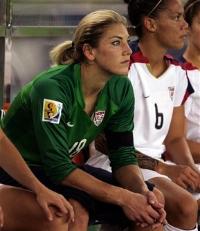
Nigeria - and in particular Dede (pictured here) - deserve much credit and admiration for fighting on, and keeping Germany to a single point (Final score: 0-1). Super Falcons: Left Wing sends you her best cross in sympathy! I was rooting for you!


PS: Nadine Angerer looks a lot like Joaquin Pheonix. Don't you think?


[August 12: On their site, FIFA says of this match that Nigeria had poor finishing - they call it "profligacy in front of the goal". But then they also go on and on about Angerer, and wonder if she's on her way to keeping a clean sheet through yet another international tournament. Well: Which is it? Because Nigeria had plenty of shots on target. And you can't have it both ways! Nigeria gave Angerer a much tougher game than Germany gave Dede - though Dede did have some great saves. Anyway, it's just yet another lame moment in the very thin English language reporting on games not involving the US! Angerer is a brilliant keeper. The best teams, the best strikers in the world have failed to convert their 'chances' in front of her.]

Wednesday, August 6, 2008

Day One: Olympic Women's Football (Brazil/Germany; China/Sweden)

What an interesting day. Given my location & internet connection, I was only able to see Germany/Brazil (0-0) and China/Sweden (2-1). As much as I wish I could have watched North Korea and Nigeria (two really interesting teams for all sorts of reasons - skill, history, international football politics), and I wish I could have seen more than highlights (or, really lowlights) of the US/Norway match (0-2), I have a feeling I may have watched the best matches of the day!

Brazil held Germany to nil - no small accomplishment. If I remember correctly, the only team to do that in the 2007 World Cup was England (on the absence of a UK squad, see this post). Eurosport France announcers called it "un beau match", and it was. Lots of action, some great shots and you could feel the tension right from the outset - Germany's Angerer is a fierce presence in goal, and Brazil seemed intent on letting her know they weren't afraid of her, so she took a bit of a beating in this game (not with shots so much as with strong challenges for the ball).

I like the look of Brazilian midfielder Formiga - always have ("formiga" that means ant, right? her given name is Miraildes Maciel Mota). The lady is not afraid to hold onto the ball - she plays with a lot of confidence and has some nice - actually genius - moves. (Pictured above, as she works her way around Lingerof.) Everybody talks about Marta and Cristiane - but I think Formiga is the glue & the gas. Holds things together and gets things moving.

Anyway, some highlights include a fantastic flying fingertip save from Brazilian keeper Andréia (Did I imagine that? Because I haven't seen it mentioned in coverage so far). I was watching in a local sports bar, and they kept turning off the sound - and looked not so amused that I was there. In any case, I'm not sure whose shot that was (Smisek?). This was followed by a speedy counterattack & gorgeous cross from Marta right across the goal mouth to Cristiane who sent it over the net with a header as she raced into the space.

Toward the end of the first half I found myself thinking Brazil looked more nervous - sending balls too far up the field, kick and run except not really. They gave away a fair amount of balls that way, and you rarely saw Germany making these kinds of mistakes.

That said, Marta looked great - her speed is amazing, and it takes as many as three people to contain her. And Cristiane is an Amazonian warrior. Over all - as clichéd as it is to say this - Brazil was nicer to watch on the ball. Turning, twisting, playful sole-rolls and crazy little flips - plus, they play chancier football. Lots of speed, quick and surprising movements, and an ability to just pluck the ball from the air - they have a lightness of touch that feels risky from the stands if only because it looks like there are moments when no single player HAS the ball - the ball is moving so fast between them.

Germany are confident - they look almost unflappable. They made very few (no?) obvious errors - few careless or pointless passes. You can feel how well they know each other. Plus, they are sneaky as all get out. Don't let the Germanic-machine-myth let you think that this team is predictable. Prinz in particular is so quick with a shot - she shoots through an open space with a lightening reflex, and she's hard to read: she looks very, very hard to defend. One pistol shot from the top of the box went just wide before you knew it'd even left her foot.

Brazil looked fantastic (up to a point) in the second half - it felt like the game was mostly played in Germany's territory. Cristiane had a spectacular shot on goal which deflected off of Angerer (very unusual). Defender Costa followed up with a shot that hit the top right corner of the post and bounced just outside the goal area. Nevertheless, they struggled to convert - as usual, no lucky breaks. But, we make our own luck in this game, no? I kept thinking if Germany had these chances, they'd be up by six. But, amazingly, they hardly seemed get inside the goal's postal code.

Over all, neither team let the other get all that close to the goal. Brazil had more shots on target, but Angerer really never seemed stretched. The last few minutes were pretty boring as both teams seemed content to let the draw stand. It is not right that they are in the same group.

Re: China/Sweden -China looked fantastic, and not just because the Chinese WNT has the best haircuts. Check out defender Li Jie (on the left) - shortlisted for FIFA footballer of the year in 2007 - or forward Han Duan (on the right - who scored the game winner) - also highly ranked in the same year by FIFA. These mug shots from the official Olympics team site don't do them justice. The whole team looked amazing in every single way, and more than half were sporting what I think is called a shag. We see this in England a fair amount - a very punky, scrappy and cool look for the woman athlete who likes her hair and wants to resist the whole pony-tailed "I am not a lesbian" thing.

Based on today's performance, it would make a lot of sense to see the Chinese team in at least a semi-final match. They more or less ran circles around Sweden - they looked more fit, confident, and like they wanted the win more. And, no doubt, they do.

And, lastly, a word about the US defeat today. Why is it that when the US women lose, they look just plain awful? Great teams lose great games all the time. But the USWNT - which rarely loses ever - seems to only lose once in a blue moon in spectacularly bad games - by giving up own goals, making fatal passes, looking like they just woke up. They didn't lose today because Norway played brilliantly. They lost because they made two really nasty errors within 90 seconds of each other. Bad communication, a weak and amateurish pass. Not to sell the historic rivals short, but Norway would have been incompetent had they not capitalized on those errors. They certainly deserve the credit for coming onto the field ready to play!

OK. Back to my day job.

Wednesday, July 30, 2008

I Love LA: Girl Kicks Ball thru Randy's Donut

I don't often share viral videos on this blog, but: Two girls (a midfielder & a winger) from Santa Monica High School Women's Soccer Team show their love for LA monument Randy's Donut. (Note the last line: "Let's see Mia Hamm do that!")

Wednesday, July 23, 2008

Canaries in the Coal Mine: Brazil in Beijing, Great Britain at Home

It's been observed that the Brazilian women's football team could use a little luck. They've been *nearly* to the top in some huge games, including the finals for the 2007 World Cup (they lost 2-0 to Germany) and 2004 Olympics (2-1 to the US in extra time).

But, alas, at the Beijing Olympics As Canarinhas find themselves in the group of death which includes two-time World Cup champions Germany (their first opponent), very solid North Korea, and the talented Nigerian side - the latter is the best African women's team, with a lot of desire and a lot of women playing in European leagues (this may be the group in which more players have experience playing with and against each other in their club sides).

The top two teams in each of the three groups advance, as well as the two best third place teams. In Group B that should be Brazil and Germany. If Brazil holds their own against Germany in the opener (August 6), they might take the whole thing - you can make your own luck if you have the confidence, and a good performance against Germany could shift Brazil's sense of itself as the perennial underdogs.

For a good introduction to what's at stake in that opening match, check out this video (from ole ole) of the award ceremony closing the World Cup: You'll get a briefing on the best players of the two teams. You will also see the Brazilian women holding up a sign that says, in Portuguese, "We Need Support" (at about 12:20) as they file past FIFA officials and pose for the cameras.

In this October 2007 post New York Times blogger Jeff Klein describes a letter sent by the women to their national federation after the World Cup (you can see it here on O Globo's site). It responds to their federation's public statements of support for the team given their outstanding performance in the 2007 World Cup. The women point out that the federation made similar promises in 2004, when they nearly beat the US in the competition for the gold medal, and that they had still not been paid award money from their win in the Pan American games. They point out how little money they earn as a per diem, and the lack of staff support for the team. Like perhaps a majority of women involved in the game (especially outside the US), the players were quite cynical about official statements about the federation's interest in their game - they'd heard it all before.

The story of their team is incredible, and it is the number 1 reason why every football fan regardless of gender should give the women's game some of their time this summer. Imagine growing up in the country that loves football the most - where futebol shapes the texture of every aspect of one's life. Where playing futebol offers one of the richest senses of pleasure and belonging available to you. Where the lore is that of the child from the favelas who becomes a god rich as Croseus and known the world over by a single name. And, you are the best player anyone has ever seen.

But you are a girl! There's no league system, and during your childhood there is not even national team. Growing up, you've been told that playing football will make you look like a man - it will make you ugly. You don't know the name of a single woman player beyond the odd girls in your own neighborhood. Take being a black athlete in a racist culture and, say, square that if you want to grasp how hard it is to develop your talent. You don't even have segregated games to turn to. You are vulnerable to every violence prejudice has to offer. You don't give a shit, because you are a genuine freak. It makes you tougher. You love the game so much, and play so well, people forget you are a girl. People play YOU. It's a great feeling. You play with boys until local associations force your manager to take you off the roster - something the manager is loathe to do, because you are so much better than the rest. Which is, of course, why they noticed you were there in the first place.

The shitty thing for girl footballers world over is that you can get away with playing on boys teams - as long as you don't offer them any competition. The minute you do, they want you off the pitch. God forbid you should be the best player that local league has ever seen. In some contexts, having that kind of talent as a young woman footballer is like having a target around your neck. It's a gift and a curse. But by some outrageous combination of good luck and blind determination, you end up playing in a different environment - like Sweden - where your talent is both accepted and nurtured, and where playing football as a woman doesn't carry quite the stigma it does elsewhere - like, say, in England. But, now you play in the snow. A lot of the women in the Olympics have this kind of story - Marta's story being the most famous (for more, see Alex Bellos's Observer profile).

Women's football isn't just not supported in many countries - it's undermined by national federations for whom managing the game is more about keeping women in their place than it is about celebrating their football culture as it is embraced by both men and women.

On this point: at least the Brazilians are IN the Olympics. We can't say the same for England - who had arguably the best game in the 2007 World Cup against the eventual champions (0-0 draw in an early match). The top three European teams in the World Cup should have gained an automatic place in the Olympics, but the disorganization of the women's game as it is managed by national associations led to England's exclusion.

The Football Associations of Great Britain (N. Ireland, Scotland, England, and Whales) have been in dispute about forwarding a GB squad. The problem involves baroque conflicts between the FIFA and Olympics rules (see this BBC story), and issues relating largely to the men's game.

Even with reassurance from FIFA that the formation of a Great Britain squad would not jeopardize the status of, for example, Scottish internationals, the FAs refused to cooperate. Because of this, the women playing in the United Kingdom can't participate in the Olympics (for more on this, go here). The impact of this is much, much bigger on the women's game of course. An Olympic team benefits from lottery money (see this Telegraph story). Had these FA associations supported the team's bid, these women might have actually been able to play football for a living. Former British Sports Minister Richard Caborn railed against the injustice of this: "That these nearly all-male organisations can deny their women footballers the chance to play in the Olympics is beyond belief." Glad he said it, so I don't have to.

What does this have to do with the Olympics? English women play in a very competitive league and, like Brazilian women, live in a culture that lives & breathes football. A large portion of the English national team plays for the same club (Arsenal) and know the world's top players because half of them play in Europe. They had a much better shot at medaling than most of the teams in Beijing. It shows how the limited commitment from national organizations is a giant drag on the development of the game.

Returning to the teams that will be there: I am rooting for Brazil because they are willing to do something like carry a sign displaying how angry they were when they walked across the awards podium. That wasn't just for them - that was for all the women in their country who have talent and want to use it. And they might as well have been speaking for the Lionesses as well, who made similar complaints to the FA about the shameful support they got on their own World Cup bid. [I should add here that at the end of the 1990s, after their 1999 World Cup victory, the US women's team leaders organized a strike in protest of the poor support they received, especially when compated with the men's team, whose record was never as good as the women's. See this 2000 New York Times story for a description of the "boycott" - i.e., strike - and an explanation of how it was resolved. A nice detail: In Dare to Dream, the women recall turning to Billie Jean King for advice at key moments. - JD, Aug 1.]

As Canarinhas didn't hide their disappointment at losing to Germany with fake smiles. They don't feel grateful just for the privilege of being there. They feel entitled to the big trophy. Call me crazy, but I think that attitude is a good one. I like seeing women go crazy when they win, and look visibly pissed off when they lose.

Nobody just gives you what you want and need: You have to know how to ask for it, work for it, and sometimes you just have to take it because no matter what you do, people don't think you should have it. They are bad ass footballers, through and through. It's high time they took a champion's medal home. Or back to Sweden.

Ich Roque

I've had company, am trying to write the stuff I'm supposed to write, and it's downtime in the footie universe. So, for the moment let me just share this awesome video my guest shared with me: It's a German band called Sportfreunde and their song celebrates one of my favorite rising stars (and object of transfer gossip), Roque Santa Cruz. The song's title & refrain pivots on a word play (apparently in German when you say "I'm Roque" it also means "I Rock"). If for some bizarre reason you aren't familiar with the appeal of this Paraguyan international - formerly of Bayern, and for the moment at least of Blackburn - check out this homage, which will bring you up to speed on his Chachi Charm, and this 9 minute celebration surveys his skillz. Or, if you are pressed for time, check out this more reasonable three minute review. Enjoy!

Tuesday, July 8, 2008

Class, Gender & Going Solo

A while back, the US Women's National Team went through some major convulsions around the comments Hope Solo made after she was benched during the 2007 World Cup match against Brazil. She watched her team not only lose, but get humiliated - this, after having shut out the last teams she'd faced. After the game, she said she thought the coach was wrong to bench her, and that she thought she could have made the saves her (older, more experienced) teammate Scurry missed. She made these comments right after the game.

Solo's brief expression of anger, frustration, and disappointment made big news. Bigger news, in fact, than the loss which was in and of itself far more scandalous. The US looked awful. Slow, no creativity - they seemed to have fallen apart. As tough as Solo's remarks were, as has been said elsewhere, a keeper who has been benched should have this attitude. It's a sign of her confidence and competitiveness. Solo's remarks were impolitic, but they made sense and hardly hold a candle to the self-aggrandizing crap that comes out of Premiership players every day.

Retribution was to be expected. What Solo experienced was of a different order - much more than a simple ego-check. She was benched for the last World Cup match, and, incredibly, was asked to not even attend the game. She flew home on a separate plane, and was placed in social Siberia by, it seems, all but one of her teammates (Carli Lloyd - from my alma mater Rutgers).

Isolating one of the country's very best keepers so dramatically at a moment when your team has just lost a key World Cup match is, well, it's unbelievable. It shows a commitment to the group that exceeds the group's commitment to the team.

Sports Illustrated published a fantastic article on the whole episode (Hard Return), and back in April Kurt Streeter wrote about Solo in his column for the LA Times (Hope's Father). The SI article shines some light on the culture of the USWNT as it undergoes a serious overhaul on and off the pitch with the arrival of their new coach Swede Pia Sundhage. In her article "Feminine Mystique" (Sideline Views), Andrea Canales speculates on the sources for that atmosphere - and suggests the historical roots of the team in UNC Chapel Hill (which has one of the most successful programs in NCAA women's soccer) in both its player roster (going to the Olympics: Heather O'Reilly, Lindsay Tarpley, Lori Chalupny and Tobin Heath - former players include: Lorrie Fair, Mia Hamm, Kristine Lilly, Carla Overbeck), and coaching staff (Anson Dorrance who coached the team from 1986-1994 has been UNC's head coach since 1979). In that article A.C. suggests that the general philosophy of UNC's program may perhaps still shape the culture of the team, which Sundhage describes in the SI interview as "sorority-style." Ouch.

Now, team psychology is complicated - when that team is winning, it's praised for its unity, when it's losing, that unity is condemned as slavish devotion. Note the eternal Arsène Wenger question. Genius? Or mad professor out of touch with the real world?

Anyway, much has been made in the wake of the "Solo incident" of how girls stick together, how women's teams operate as a complex social organism. There is of course truth to this.

I want to point out, however, that many of the qualities that define that sort of mentality (in which there is little room for dissent or the direct confrontation of difference) look as much like class things as they do gender things.

Think Carol Brady. Then think Roseanne.

I know absolutely nothing about what playing soccer at a Division I NCAA school feels like, and my thoughts here are about the public face of the team, and media representations of US women's soccer - but when I was reading the SI article, I found myself thinking about what AYSO soccer culture looks and feels like in some parts of the country (moms & mini-vans, families with the money to register their kids in traveling clubs, living in neighborhoods with good field access and good athletic programs at area schools). The public face of women's soccer can feel really white (regardless of the diversity of the national team), and really middle class. If this commitment to the group above all else is how women are expected to behave, those expectations have a *lot* to do with class aspiration, with class policing.

That sorority-style thing is not "simply" a girl-thing, in other words. In fact, I'm going to say it might be even *more* about class than gender - if women are expected to have an easier time fitting in and working as a group, if women are expected to prefer to avoid rocking the boat, if women are expected to swallow their anger in favor of communal harmony - well, the community imposing those expectations isn't simply female.

When I've been in groups of women from more working class and immigrant backgrounds, when I've been in groups of people that are more diverse, I've found that we are more likely to express disagreement. I've found more dissent, but also more conversation - more willingness to deal with it.

Not all groups of women are the same. Any weekend soccer team can tell you this - because in a season you play against teams with wildly different personalities - personalities that, in part, reflect the backgrounds, neighborhoods, and sensibilities of the women on the roster.

If male footballers in the UK have a propensity to act like assholes when they are asked to sit on the bench, or if they speak up or act out when they think someone on the team has really fucked up, maybe that's partly because they are somewhat less likely to have spent their formative years sitting at middle class dining room tables making small talk about whatever it is people talk about in such settings. Or, if they did, the culture of the game requires they keep that in the closet (or end up ostracized like the Guardian-reading, gallery-going Graeme Le Saux).

The way male footballers act has as much to do with their own class backgrounds & the class culture of football as it does with gender - if not more.

Regardless of their socio-economic backgrounds, top US women soccer players spend four years at a university that basically disciplines you into being a "good girl". But I'll bet university teams have really different personalities, dependent on the student body that it represents. Chapel Hill is a pretty conservative campus - and although it's public, it is one of the most elite schools in the country. (Their sorority scene is intense. ) I wonder what the Rutgers women's soccer team is like? University of Washington (Solo's alma mater)? My own campus, UC Riverside?

I like to think that as grassroots soccer culture expands in the US, the culture of the game will become more open - that as more girls from diverse backgrounds take the field, we'll get to see a game face that is less "perfect", and more bad-ass.

Thursday, June 26, 2008

Futbolus Interuptus

My worlds collide! It's the first night of a symposium on feminist art, and the speakers are all having dinner. I'm in my hotel room, in the thrall of the electric battle between Turkey and Germany. Adrenylyn has every sense heightened - I feel like I am actually on the pitch - my heart is racing nearly as fast as the Spanish commentators are calling the game. The Turkish players are teaching me the full meaning of extending one's self. They are reaching into passes to scoop the ball up with the very tip of a toe. They just barely gain control of the ball before moving it forward, forward, forward. When their first goal comes, it feels inevitable, even as it is scrapped into the net after bouncing off the top bar. And then...well, let's just say I hate it when Germany scores - it's so clean, it's so, well, efficient.

The Germans then have me experiencing defensive flashbacks: Remembering how terrifying it is to be on the back line (in spite of this blog's name, and my fantasy position on the pitch, I usually play left back). You have to think faster, be faster than the opposition. You can't make one mistake, you can't pause or hesitate for even a shadow of a second. Keeping that level of concentration for 90 minutes is well and truly hard. I'm exhausted by the end of the first half, but excited: Turkey feels like the better team.

And so, I did something totally scandalous. I joined my colleagues at the restaurant. True, there was a t.v. on in the front bar, and I could catch the score at polite intervals. But, basically, I couldn't take it. I wanted Turkey to win so much that I couldn't bear to watch them lose - especially given the way they were playing. Nothing could convince me that they deserved less than the history making upset. I think it was their style - the scrappy, throw yourself totally into it sort of game that I think every player loves. They were playing like we do in our parks on the weekends. Or, like how we play in our minds - how we play in the stories we tell when we head off to the pub, or the local taco stand, and elaborately work over the games high and lowlights.

I mean, definitive endings are over-rated, right? Wouldn't you have liked to have gone to bed with Turkey giving Germany the scare of their lives - as if the first half was a never ending story.

Wednesday, June 18, 2008

Back Talk: Does Sex Really Sell Women's Sports (A: NO!)

Way back in December, I posted an article about Hollywood United's "sister" team, Hollywood United Girls Soccer. My read on them was pretty strong, and recently some members of the team have written in with their perspectives. The result has been a really interesting conversation about the use of "sexy" images of women to sell women's football (e.g. their promotional video) and women's sports. They have a lot more support than the great majority of teams playing at their level: But that support comes at what cost? Does the use of the sexual attractiveness of a team to gain publicity & sponsorship deals help the sport?

I hope to do a follow up story about how the women on that team have changed & evolved in relation to their image as a team. Meanwhile, Dave Zirin at The Edge of Sports has posted a spot-on critique of this practice, and brings to our attention the work of gender & sports academic Mary Kane - who has proven through research that the sexualization of women athletes does far more harm to women's sports than good - by profoundly alienating both women and men (who care about the women athletes in their lives) from sports culture. See this interview with her about her work on this topic. (I mention Kane in my rant about the Guardian article below.) Dave Zirin, Mary Kane: Left Wing sends you her best cross!

Sunday, June 15, 2008

Lame Journalism: Observer Story on Injury and "'Warrior' Girls"

Because newspapers are lazy, Observer readers this weekend are being served recycled slop originally dished out a few weeks ago in the New York Times ("'Warrior' Girls Run the Risk of Injury"). Like the NYT story ("The Uneven Playing Field") the Observer spins a scary - and condescending - headline from the most regressive aspects of Michael Sokolove’s book on the “injury epidemic” in women athletes.

This story is short, and so doesn’t even have the complexity of the NYT Sunday Magazine piece – its whole attitude stinks with the totally unexamined sexism of UK culture when it comes to women athletes.

For example, the story makes news of the fact that when women athletes ignore their injuries, it has a drastic effect on their health. RRRReally?! Anyone tell Wayne Rooney – hey, with all those metatarsal fractures, think you should keep playing? He's hardly alone - it's a very common injury for footballers. Man, Thierry Henry’s back wouldn’t hurt so much if he just stopped playing. Think Eduardo de Silva plans to retire from football just because Taylor broke his leg? And: Let’s remember that Ronaldo’s most recent knee injury wasn’t his first. Any stories in the sports section in which journalists breath the slightest suggestion that football is too rough to play because men get hurt??? And what's with the scare quotes around 'Warrior', and what's with the word "girl"? The Observer article doesn't focus on girls, but on adult women playing at the highest levels.

I’ve covered the ground regarding ACL/cruciate injuries and women athletes before ("Sexism Hurts"). And I agree – there is a story in the subject. Just not the story people want to tell.

But here I will just say this: Things are worse in England than in the U.S. Sure, there are people out there who support women’s sports, but the generic cultural attitude is still in the dark ages. Just look at the amount of space The Guardian/Observer gives to women’s sports, for example. Next to nothing. There shouldn’t be a single day in which their sports section excludes coverage of women’s sports. And we should not have to wait for people like David James to use his column for perspectives on women’s football (he’s the only one who does so with any intelligence). Why doesn’t the Guardian or Observer (or any other paper) have a woman columnist (and I mean a serious writer) invested in the women’s game??? (Please tell me I'm wrong and give me a link to a monthly column on women's football written by a woman in a national paper.) Is it only acceptable to write as a feminist when it comes from a Premiership and national men's team player?

An alternative view of sorts concludes the article:

Others, however, are concerned that drawing attention to the issue will backfire. 'Sex differences can easily be perceived as weakness,' said Mary Kane, director of the Tucker Centre for Research on Girls and Women in Sport. 'We need to do everything we can to prevent injuries. But it does seem that there is a disproportionate emphasis on things that are presented as signs of women's biological difference or inferiority.'

But this isn't, in my view, enough of a portrait of the concern many of us have about the presentation of the issue. Why doesn't Kane's concern lead the article? Why present it as an afterthought? Again, see "Sexism Hurts". It isn't that we don't want to discuss the issue - far from it. We want it presented in the same way that we present issues regarding male athletes. Taylor's tackle on Eduardo de Silva, for example, sparked an important conversation about the complexity of the physical side of the game. Let's allow ourselves to have that kind of conversation about women athletes, injury, injury prevention, and recovery.

That story about women athletes and injuries should be a big story in the sports section.

Why don’t journalists track down the members of the English women’s national team who’ve suffered from these injuries and talk to the doctors and physiotherapists who treat them? How about stories about how hard these women have fought to come back from these injuries? OR – perhaps more compelling: what happens to them when they can’t play? Where do they go with all that passion for and knowledge of the game?

Ask top athletes who’ve suffered career ending injuries if they regret it (who among them would say they’d rather never have played??). (The only athlete they interview is Katharine Merry - a sprinter – and runners don’t suffer the kind of knee injury that is the subject of discussion! The injuries sustained by Merry are absolutely identical to all athletes of any gender who train and compete at very high intensity from a young age.)

Cover the advances in training – I think people would be interested in learning exactly what the differences are between men & women athletes. I mean, we get stories about differences in how men and women talk, how they think about sex, how they approach raising kids and managing colleagues in the workplace. How about how men and women play the game? Like: Do women dive as much as men? Do they give referees attitude like the men do? Do women play dirty? What kind of reputation do the women’s teams have?

But jeese. Don’t give us stories about how fragile women are! I’m sorry – but I took some hard, clean tackles that sent me ass over tea-kettle in the mud last week, and it felt GREAT! There’s nothing like knowing your opponent feels you as a threat. There’s nothing quite like getting up and playing on, not just because you want to show that you can’t be scared off the field, but because they’ve just upped the ante, and you plan to take that ball back come hell or high water.

Don’t pander to the sexist attitudes of the lowest common denominator. Some people here in England have their heads really far up their asses. Many would rather their women drink until they are falling over, fatten up, and breed than get in their kit and take the field. And no one is going to change those attitudes by pandering to them! So OBSERVER: SHAME ON YOU! You made me so mad I blew off my Sunday kickabout so I could rant!!!

Personal Reflections from a Left Back (Clacton 7s)

I’ve been quiet on the blog in part because I played for Hackney in the Clacton 7s tournament last weekend: What a blast! The level of play was fantastic. It was really hard. You couldn’t lose your focus for a second, you gave ground with every mistake. It was unforgiving. I can’t get enough of that sort of game – a real challenge, mentally and physically.

This was the first time I’d tried visualizing before a game. I think it gave me confidence, and maybe improved my reaction time.

I had one or two seconds of glory playing left back. There were a few moments when I could see myself clearing the ball, when I knew I was going to get my foot on it – and then I did. In one game, I could see one woman’s determination to get a shot off, and tracked her back and forth across the box until she lost the ball and it was cleared. She turned around and pushed me by the shoulders in frustration – I’d played 100% clean, hadn’t even touched her, so I take that as a major compliment.

It goes to show you – don’t show defenders your cards. In my limited experience, the best strikers are really hard to read: they have a poker face. If you can see someone really wants to get that shot off, you know they are unlikely to pass the ball. You can corner them, frustrate them, wind them up by limiting their movement. The cool headed ones won’t let you get close enough to know what’s on their mind. They’ll slide the ball into space where a teammate will pick it up, and poof, they are gone and you are looking at the back of their shirt.

Weak moments for me abounded last weekend – from being too scared to run forward and offer support to our attackers, to being so happy to block a shot that I really didn’t think I could catch that lost my focus and didn’t track the rebound – which the gal caught, and spun right into the goal. ARGH. It was a fantastic goal though, shot from nearly behind the goal’s mouth, and spun just right: it hit the ground about a foot in front of the goal line and bounced right into its target. There’s a Nike ad in which Thierry Henry does the same. At first I thought: Well, it’s an Henry-like goal, and I’m not good enough to stop a trick like that. Then I thought: I’ve seen that ad a dozen times, and I should know better – I know it’s possible, and I knew that that girl (no. 10/London Colney) had some moves. So: My bad. She's the tiny one pictured standing out of bounds.

The incident just goes to show how much attitude impacts play: If I’d approached her with more confidence, I might have attacked the ball with more force. She was stone cold ruthless, and knew she had me.

Overall our team did really well – making it into the top end of the tournament for the second day’s games. We held our own against some really tough opponents. I suspect we may have had one of the best records defensively. Alfie, our goalie was a superstar – absolutely awe-inspiring – she won keeper of the tournament in fact. Hooray!

Thursday, May 29, 2008

Shameless Self Promotion

Frieze just published a short essay I wrote on some recent art about football - you can see it on their site and of course in the print issue on stands throughout the summer. I think it might possibly be a first for the magazine - I'm thrilled to be leading the charge into the world of contemporary football art criticism (right, 'ecstasy' by Yrsa Roca Fannberg, one of my favorite artworks 'about' soccer). Note: I discuss a Hellmuth Costard experimental film from 1970, Football As Never Before (due for a DVD rerelease in Europe this month). There are clips of this crazy/beautiful study of George Best at work in a match against Coventry on You Tube - totally worth checking out. I'm taking a breather from the blog until I get back from Clacton - expect a full report on the sweaty glory mid June.

Friday, May 23, 2008

Feeling It: Sentimentality, Football, & Eamon Dunphy's 'Only A Game?'

News flash: women don't have a monopoly on melodrama and sentimentality. Witness Lampard's emergence as a national icon via his admirable performances for Chelsea while mourning his mother - his eyes turn to the sky as the back of the net bulges and the crowd cheers. You can feel the whole country choke on its tears. Or, John Terry's collapse on missing his penalty - an unlucky slip of the foot unraveling a night of superhuman work on the back line.

Whose heart didn't break at the injustice, the bad luck? At the grim irony that the man so easy to love would take the burden of his team's defeat when the man so easy to hate (C. Ronaldo) would wear a crown of glory - after he had nearly cost his team the championship with his approach to the ball - an arrogant cha cha cha that itself nearly wiped out the authority of his earlier goal. If you've ever stood in goal, you know Cech felt a malicious thrill watching C.R.'s smug little dance, knowing the wave of schadenfreude he would soon unleash as he scooped up the ball. I know I lept out of my seat and shouted with joy.

We like to think that sentimentality & melodrama belong to soap operas & chick flicks like Stella Dallas or Terms of Endearment: to those of us who organize our days around General Hospital, Neighbors, or Maria La del Barrio.

Fact is, though, the emotional intensity of those programs pales in comparison with that of a big match. You will see men wrap their arms around each other in drunken tenderness, sing together as their teams go up, weep together as their teams go down. Their eyes will mist over as they remember the glory of Baggio or Garrincha or Best, and indulge a nostalgia for the days when the game seemed more honest, more real.

So when Nick Hornsby writes "what sets [Eamon Dunphy's Only a Game?] apart is its honesty and lack of sentimentality" I must ask why anyone would need to disavow this aspect of Dunphy's writing - or indeed of the game itself? The only book about football I've read that is devoid of sentimentality is the comparative economics study, National Pastime: How Americans Play Baseball and the Rest of the World Plays Soccer.

Only A Game? is a memoir of Dunphy's last months playing for Millwall in the 1973-4 season. It is a classic in sports writing - by far the most compelling book I've read about the game. Dunphy writes with tremendous honesty about how it feels to be a part of a team, how it feels to play (his writing on being a sub is ruthless and 100% spot on). He's also shameless in avowing his ideas about how the game should, and should not, be played.

He is particularly frank about the emotional, personal, and even sentimental aspects of football culture.

Take the following passage:
When you share a job with somebody in football, a relationship develops between you, an understanding that you do not have with players doing a totally different job. If you are just knocking a ball between you, on a training ground, a relationship develops between you. It's a form of expression - you are communicating as much s if yo are making love to somebody. If you take two players who work together in midfield, say, they will know each other through football as intimately as two lovers. That would apply to Giels and Bremner, for example. It's a very closer relationship you build up when you are resolving problems together, trying to create situations together. It's an unspoken relationship, but your movements speak, your game speaks. the kind of ball you give each other, the kind of passes you give each other, the kind of situations you set up together, speak for you. You don't necessarily become closer in a social sense, but you develop a close unspoken understanding. (Dunphy, 30)

I nearly dropped the book when I read this. I couldn't agree more: One the real pleasures of the game is that feeling of total communication with your teammates, with especially those playing with you on the field (the connection between left back to left wing, between the back four, midfielders to strikers, goalie to the back four, forwards to each other, etc.). It's wonderful to have that kind of intimacy with people without having to talk, really. Dunphy is writing honestly and with a shocking absence of homo-panic about a nearly unspoken truth about the game: When things are going really well, it feels like romantic intimacy. And because of this, you can "fall in love" with players via the game.

There are a hundred other reasons to read Only A Game? It is written from within the game - and is really eloquent about what makes a game feel like a great game from the player's perspective. About how certain kinds of defeats feel OK, others are soul crushing - and that in fact victories aren't always sweet.

He is most romantic about the good pro - the self-effacing, hard working, totally dedicated teammate. The person who never tires - or who pushes him/herself past the limits of tiredness, who looks after their position, but also that of their neighbors - the person who 'has your back':

If you are in the shit, having given your man that crucial extra yard or two, have lost your concentration for a minute, the good pro will often rescue you, leaving his man to get in a saving tackle or making what looks to the crowd like a simple interception. He is woven into the fabric of every good side and every great side too. (Dunphy, 13)

Now - here's my cross. That kind of person - the person who knows that their glory is only enhanced by your glory - that playing the game well involves a heavy element of self-sacrifice - that kind of person is the heart of every good tear-jerker, every classic melodrama: it's Stella Dallas, the mother who makes a terrible sacrifice so that her daughter might have a chance at a better life; it's Annie Johnson, the maid/mother who sacrifices herself for not only her daughter, but her employer too. These women make the lives of other people possible at great expense to themselves. It's why these are such problematic genres for feminists, who worry that these stories only serve to make women complacent about the myriad of forms of self-sacrifice foisted on them in their daily lives.

The stories played out for us in stadiums and on Sky Sports perform a parallel version of this: men giving themselves over to something larger - but at the expense of so much - like: it's ok to love one another just as long as you never, ever speak it. It's ok to cry, as long as it never, ever makes you womanly. It's OK to try, as long as you never, ever fail.

So we arrive at the evil flipside of masculine sentimentality: sure, men cry in these arenas - but they often turn around and "correct" that display with a punch, with a kick, with a head-butt. Worse, players and fans carry that conflicted relationship to feeling, to sentiment, off the pitch, and work it out on the women in their lives (e.g. Paul Gascoigne) or anyone who offers themselves up as a suitable target.

Dunphy's memoir is a miraculous document - most footballers who enter the public arena do so under the heavy supervision of an army of publicists all massaging their egos and their images into a Nike-worthy version of manhood, cemented, frozen expressions of rage and phallic glory.

But most footballers who take the pitch every weekend do so not because they are inspired by those kinds of images, but because they want the thing they saw their fathers enjoy with their friends: that simple pleasure of the good pass, the game well played, and that feeling of being "in it together". I don't know a single player who isn't deeply sentimental about *that*.

Related Posts Plugin for WordPress, Blogger...