Riyas Komu, Mehrajuddin (2007)
Friday, December 11, 2009
Athletes & Artists: Riyas Komu's "Mark Him"
Saturday, December 5, 2009
Left Wing, Left Leg
Riyas Komu, Left Leg 2008
I write this from Goa, just minutes before heading to a meeting with the Indian National Football Team. This is part of a research trip to India, to explore the work and practice of the artist Riyas Komu. Komu has been meditating on football for a few years now, and is as passionate a fan of the sport as I've met - and is particularly committed to the sport in India. I'll be posting articles about this trip on Art21 - and will announce those posts and link to them here. Above is one of a series of his "left leg" sculptures - carved from salvaged wood, cut through with slabs of concrete and steel cable. When I first saw one of these sculptures, I said "He plays." I knew with total certainty that the artist was a player because these pieces are phenomenologically real - meaning, they look like how a player's leg sometimes feels. Both heroic and traumatized. More soon!
Saturday, November 28, 2009
RIP: Mike/Christine Penner, Transgender Sportswriter
Los Angeles Times announced today that transgender sports journalist Mike Penner committed suicide.In 2007, Penner came out in the newspaper's pages as Christine Daniels. He took a vacation, and came back as she. Daniels continued to write for the Times, and took up what must have been no small battle in her confrontation with the ruthlessly phobic and sexist sports world. Of course, most of her life she - as he - had been living intimately with those attitudes - casual misogyny, throw-away homophobic jokes and worse are so tightly woven into sports culture as to define it.
That said, Christine Daniels reported that readers embraced her - that in fact they defied her expectations with their expressions of care and support. At the moment, the comments section for the LA Times story reporting Mike/Christine's death bear this out - if readers struggle over what pronoun and name to use, it seems to be out of a genuine desire to show respect.
About a year ago, Mike "returned." This fact left some confused. If Christine enjoyed solid support, the return of Mike was greeted with more ambivalence and judgment than compassion and understanding.
Coming out as transgender is complicated - it isn't simply a matter of opening a closet door. You don't just declare yourself a woman (for example) - you undergo therapy, you live a year as a woman while being assessed for gender reassignment, you take hormones (or you decide not to) and you explore what gender, what sexual identity and life makes sense for you. It isn't like there is one sort of femininity and one sort of masculinity - we all know this: a person may feel well defined by a term like "male," for example, but embody a radically different masculinity from his brother, who may feel just as defined by that word.
Thinking about Mike/Christine, I'm moved by the woman s/he wanted to be, and became in 2007. What would it be like to develop and express a feminine identity as a sports journalist? Women sportswriters defy gender expectations every time they go to work. This isn't a traditional femininity by any stretch. Christine, as a sportswriter, would have cut a distinctly (and queerly) feminist figure.
There is no linear route from a public identity as one gender to another. Some people try out a gender identity, and find that a stable gender isn't what they want. Maybe that person reclaims the pronoun they grew up with, and maybe they carve out a queer version of it. Maybe they settle into the new pronoun, but decide to queer expectations of what that pronoun signifies. Each person's process is different. Mike/Christine's story was unique - unfolding in a hypermasculine world, and in public. She was gracious in the few interviews she gave (listen to this one on NPR). She also fought to guard her privacy - pushing back on questions about the decisions she was making about her body, for example. We may know little about Mike/Christine's personal struggles - but recent events show us how intolerant the sports world is when it comes to the fluidity of gender identity.
Mike/Christine's suicide comes just days after the 9th annual Day of Remembrance for victims of violence against transgender people. A recent study published in the Journal of Homosexuality asserts that thirty percent of transgender people have attempted suicide. Some say that figure is very conservative, putting the number closer to half.
Let's remember Mike/Christine for being a great writer, for being brave and for helping us to imagine an anti-homophobic, queer and trans positive sportsculture. The world is a poorer place without him, without her.
Thursday, November 19, 2009
Henry's Handball & the Moral Ambiguity of Football
The ball rebounded to Thierry Henry's hand, first once and then again. He scooped it gently, and let it fall to his feet. He made a controlled pass to his teammate William Gallas, who scored a much-needed goal against Ireland. The referee didn't call the handballs (clearly visible in recordings of the match). Henry didn't ask him to. And Ireland are out of the World Cup.
The LA Times is running a poll, asking readers what they think FIFA should 'do' about Henry's handball. It's a somewhat typical response: there must be one agent responsible for evil, a clear solution to a problem. Lambert is responsible for shaming the women's game (and not the referee, coaches, and the players on the field whose passivity allowed all that to happen); Thierry Henry is a "cheat." The demand for Henry's head - or for his hand - makes for good copy.
For something a little more complex, see The Guardian's interview with Irish sports journalist Barry Glendenning (one of a slew of articles on this subject, representing a range of perspectives). Of course "we were robbed by France," in a move that "would be illegal even in basketball," he comments. (Is he referring to the double-dribble?) Henry is shown describing the handball frankly in a post-game interview (transcribed in French here). Where the American press casts his statements as "unapologetic" European journalists see it more nearly as "frank" and "honest." Of Domenech's support for Henry, Glendenning says "If any Irish player had done the same, I'd fully expect the nation to be 100% behind him." He also points out that Henry's image has already been so compromised by his "previous chicanery" that this incident can hardly be said to be all that damaging to the star's reputation.
"Cheating" is an art in this sport. Everyone is of course remembering Maradona's "Hand of God" goal. Maradona discussed it in an interview for the BBC: "This is something that happens...I have scored goals in Argentina with my hand." He goes on to explain exactly what he did, and how he "sold" the goal to the linesman. (The Guardian's Richard Williams minimizes Maradona's intentionality by calling it a "street kid's instinct" in his column chastising Henry from whom he expects better given his relative "sophistication": This is wildly classist - a fantasy of a pan-Latin 'favela' - and totally ignorant.) There are myriads of smaller incidents - daily actions in which players exploit the deeply subjective nature of some of soccer's most fundamental rules. Handballs, offside calls, the identification of goals and the discounting of goals, calls for aggressive tackles and diving - all are made by referees without the help of video replay, and are vulnerable to human error and players know it - and the most competitive exploit this. It becomes part of your game.
The French press sees the handball as representing a larger crisis on the squad stemming from the limits of Raymond Domenech's stewardship. (For a taste of the mood regarding the national squad, see this match report - "Voyage au bout de la nuit" - from So Foot. It opens with "Blood on the dance floor. 5 minutes of play and the face of Julien Escudé, taking the place of Eric Abidal, is already cut open after a run-in with...Patrice Evra. The tone of the match is set. The Irish have already invaded the French camp.") The European press (and the soccer-blogging community) wonders why on earth France holds onto Domenech. France has at its disposal one of the most talented populations of players on earth - French athletes are stars in squads of stars, playing for the best clubs in the world. And yet as a national team they limp along and seem increasingly disaffected. If the French public turns against Henry (and it has, again and again), it's out of a broader disappointment with a side whose fate turns on such an ugly incident. Who wants to win this way? Well, the people who want your money.
Eduardo Galeano described 'the history of soccer' as a 'sad voyage from beauty to duty.' That 'duty' is paid to the sports 'telecracy,' which demands that its 'functionaries specialize in avoiding defeat.' If Thierry Henry didn't, say, clear the ball from the goal (which would have been so chivalrous as to be completely scandalous), if he played the ball to his feet and passed to Gallas, he was being a good employee. And it is ridiculous for us to expect anything different - if you want an honorable game, you are far far more likely to find it in a neighborhood park than you are on your favorite sports channel.
This morning a friend reminded me of Albert Camus's famous assertion: "Ce que je sais de la morale, c'est au football que je le dois." ("What I know of morality, I owe to football.") This statement has been interpreted differently by sports writers - to suggest the clarity of moral obligations within a team, or to suggest the moral ambiguity of football.
How we read that statement depends on what and whose football we are talking about - just as how we think and feel about Henry's handball says a lot about what game it is we want. Are we talking about football played for beauty and pleasure? Or football played for work and profit? How can we keep the appetites of one from spoiling the joys of the other?
The LA Times is running a poll, asking readers what they think FIFA should 'do' about Henry's handball. It's a somewhat typical response: there must be one agent responsible for evil, a clear solution to a problem. Lambert is responsible for shaming the women's game (and not the referee, coaches, and the players on the field whose passivity allowed all that to happen); Thierry Henry is a "cheat." The demand for Henry's head - or for his hand - makes for good copy.
For something a little more complex, see The Guardian's interview with Irish sports journalist Barry Glendenning (one of a slew of articles on this subject, representing a range of perspectives). Of course "we were robbed by France," in a move that "would be illegal even in basketball," he comments. (Is he referring to the double-dribble?) Henry is shown describing the handball frankly in a post-game interview (transcribed in French here). Where the American press casts his statements as "unapologetic" European journalists see it more nearly as "frank" and "honest." Of Domenech's support for Henry, Glendenning says "If any Irish player had done the same, I'd fully expect the nation to be 100% behind him." He also points out that Henry's image has already been so compromised by his "previous chicanery" that this incident can hardly be said to be all that damaging to the star's reputation.
"Cheating" is an art in this sport. Everyone is of course remembering Maradona's "Hand of God" goal. Maradona discussed it in an interview for the BBC: "This is something that happens...I have scored goals in Argentina with my hand." He goes on to explain exactly what he did, and how he "sold" the goal to the linesman. (The Guardian's Richard Williams minimizes Maradona's intentionality by calling it a "street kid's instinct" in his column chastising Henry from whom he expects better given his relative "sophistication": This is wildly classist - a fantasy of a pan-Latin 'favela' - and totally ignorant.) There are myriads of smaller incidents - daily actions in which players exploit the deeply subjective nature of some of soccer's most fundamental rules. Handballs, offside calls, the identification of goals and the discounting of goals, calls for aggressive tackles and diving - all are made by referees without the help of video replay, and are vulnerable to human error and players know it - and the most competitive exploit this. It becomes part of your game.
The French press sees the handball as representing a larger crisis on the squad stemming from the limits of Raymond Domenech's stewardship. (For a taste of the mood regarding the national squad, see this match report - "Voyage au bout de la nuit" - from So Foot. It opens with "Blood on the dance floor. 5 minutes of play and the face of Julien Escudé, taking the place of Eric Abidal, is already cut open after a run-in with...Patrice Evra. The tone of the match is set. The Irish have already invaded the French camp.") The European press (and the soccer-blogging community) wonders why on earth France holds onto Domenech. France has at its disposal one of the most talented populations of players on earth - French athletes are stars in squads of stars, playing for the best clubs in the world. And yet as a national team they limp along and seem increasingly disaffected. If the French public turns against Henry (and it has, again and again), it's out of a broader disappointment with a side whose fate turns on such an ugly incident. Who wants to win this way? Well, the people who want your money.
Eduardo Galeano described 'the history of soccer' as a 'sad voyage from beauty to duty.' That 'duty' is paid to the sports 'telecracy,' which demands that its 'functionaries specialize in avoiding defeat.' If Thierry Henry didn't, say, clear the ball from the goal (which would have been so chivalrous as to be completely scandalous), if he played the ball to his feet and passed to Gallas, he was being a good employee. And it is ridiculous for us to expect anything different - if you want an honorable game, you are far far more likely to find it in a neighborhood park than you are on your favorite sports channel.
This morning a friend reminded me of Albert Camus's famous assertion: "Ce que je sais de la morale, c'est au football que je le dois." ("What I know of morality, I owe to football.") This statement has been interpreted differently by sports writers - to suggest the clarity of moral obligations within a team, or to suggest the moral ambiguity of football.
How we read that statement depends on what and whose football we are talking about - just as how we think and feel about Henry's handball says a lot about what game it is we want. Are we talking about football played for beauty and pleasure? Or football played for work and profit? How can we keep the appetites of one from spoiling the joys of the other?
Friday, November 13, 2009
New Mexico/BYU: What happened to the Referee, Joe Pimentel?
Elizabeth Lambert's name is now synonymous with violent play. What happened to Joe Pimentel (pictured here, giving Lambert the one yellow card he issued)? The center referee basically folded his arms and did nothing through that match - was he suspended, pending some sort of inquiry and evaluation? Nope - He went on to referee a men's game a few days later: the UCLA/Washington PAC-10 championship match, in fact. Does that seem fair to you? This is in spite of the fact that the referee assignor and high level administrators were at New Mexico/BYU match. I've e-mailed the board of the National Intercollegiate Soccer Officials Association, and am waiting for a reply. I encourage readers to do the same - this is not an incident in which a ref missed sly fouls committed off the ball. My faith in the fairness and competency level of refereeing at NCAA matches is deeply shaken by not just the poor officiating at the New Mexico/BYU game, but by the fact that the referee ultimately responsible for policing such things was in essence rewarded for his failings. When do we get a public statement from him, from the NISOA and from the coaching staff at New Mexico accepting responsibility for their role in keeping an out of control player on the field?
Tuesday, November 10, 2009
On the suicide of Robert Enke
Robert Enke worked very hard over his career for his spot on the national team, playing in Portugal, Spain, Turkey and finally in the Bundesliga, for Hannover 96. He won eight caps for Germany, and was in position to be the country's #1 keeper in the upcoming World Cup. Enke committed suicide on Tuesday, November 10th by throwing himself under a train.Enke's death is a horrific reminder of the seriousness of depression, and the particular difficulty faced by athletes who suffer from it. Used to toughing out setbacks and injuries - taking the field with bone chips floating around your foot, fractures, sprains and worse - athletes struggling from depression may be reluctant to seek help, for all the ways depression doesn't register as "real enough," and for fear of seaming weak or losing their place on the team (see Dave Zirin's 2008 article about this). This was the case, his wife explained today (see Juergen Voges's AP news story): Enke feared that coming out about his depression would mean he would lose "his sport, his life."
Depression goes after the things that matter most to you, everything that brings you joy: it can take the sport that was once a source of pleasure and make it into a site of misery. I read once that depression separates people from who and what they love with "surgical precision." That strikes me as about right.
Enke's wife and doctor speak to his struggles at this press conference, available on the Guardian's website. There is no single event one can point to as depression's "cause." News stories point to the death of Enke's very young daughter, Lara, who died at two years old of a congenital heart problem in 2006. He apparently first sought treatment for anxiety and depression during his tenure at Barcelona in 2003. Given his dogged fight to break into the top flight, such counseling would be normal - just not perhaps for an athlete. Enke hovered for years in the #2 spot and worse for Europe's top clubs. If there was ever an effective external trigger for anxiety and depression, it's the precarious position of a keeper on the edge of playing for his country in the World Cup. News reports keep repeating how he seemed closer than he'd ever been to being at the top - as if this makes his depression more mysterious - but of course this would raise your anxiety, not lower it.
We can't say that any one of these things triggered his suicide. You can't "blame" conditions for a person's depression, and you can't blame the person either - they are already certainly in the vicious grip of a self-blame, which is part of the problem. The demon is the black sun of depression itself. Whether you are in its grip, or are close to someone who is, its nature is very hard to grasp - it infects the way you feel and think on the most elemental levels.
At my own worst moments (I struggled with panic disorder in my 20s), it was the non-judgmental, non-pathologizing understanding of a friend who intervened to help me seek treatment by recommending a wonderful therapist. My friend also suffered from panic attacks - it was a huge relief for me to hear someone talk about this very awful feeling from experience, because until that moment I thought I was not only crazy, but that there was nothing that could be done about it. I am not sure where I'd be today if it weren't for that conversation twenty years ago. My problems, however, were very small by comparison - anxiety is not identical to depression, though the two can go hand in hand. I was just twenty, and had almost no responsibilities to anyone but myself. And I've always been surrounded by art/intellectual/creative types - a queer sort of world where, at its best, we embrace each other's 'mental illnesses' with affection and humor.
Enke and his wife adopted a baby girl in the spring, and people seemed to think he was doing well. His wife said, however, he was afraid that public acknowledgment of the severity of depression might lead the state to take custody of their adopted daughter - he was terrified of this possibility. In his suicide note Enke apologized for misleading people around him into thinking he was ok - it was necessary for him to carry out his plan. The days before a suicide can be, in fact, a gruesomely "upbeat" period for the person planning to kill themselves - set on the plan, a person can even feel a sense of happiness, knowing that it will all be over. People around them relax (the easing up of their worry feels like a relief, because for the depressed person the concern expressed by those around them becomes itself a heavy burden, and source of guilt and shame). Sadly, we usually learn this only in the wake of a suicide, as we gather around and find ourselves saying the same thing to each other - "he seemed like he was doing better." It's baffling.
All we can know for certain is that Enke must have been in absolute agony to have ended his life like this.
In looking for stories about athletes who have been open about depression, I came across this July New York Times article about the brilliant basketball player Chamique Holdsclaw. After years of drifting in and out of the game, dogged by a depression which made the game joyless, she is back on the court playing for Atlanta. Stories like hers are important. In a 2007 Sports Illustrated profile, she explains that after the death of her grandmother
it was like I was in a box and had closed myself in. It was the one time I needed help and I wasn't letting anybody in.I am not sure how people get out of this box without help from those around them. And I am not sure how we can tell when people in our lives are in these dark places - since all too often people in the grip of this sort of depression isolate themselves, so that people around them can't see what's going on. In the world of professional sports, there is already a structure in place to facilitate this boxing-in of oneself - you don't want to be a "problem," your very livelihood is in fact dependent on your ability to project an image of yourself as invulnerable. And the goalkeeper especially is the heart and soul of a team, the person who radiates confidence outwards and whose solidity grounds us. Like baseball's pitcher, this player carries a particular symbolic weight.
A death like Enke's leaves friends, teammates and family with a tremendous sense of failure. Enke's wife comments
We thought we could do everything and we could do it with love but you can't always do it.My heart goes out to the people in his life - losing a person this way is absolutely devastating, for it seems to signal a profound failure in our ties to each other. A friend committed suicide in 1997, and those of us who were close to him are to this day marked by this sense of loss and failure.
There is no easy answer here, no smart sentence to write about this. I guess I would just say that if there was ever a moment to censor the ungenerous reflexes of sports culture - the macho , win-at-all-cost worldview, the intolerance for the possibility of failure, the disgust sports culture shows for vulnerability - and to cherish instead sport as a site of collective pleasure and interpersonal connection, this is it.
Sunday, November 8, 2009
ESPN does an ACTUAL story about the New Mexico/BYU match
Watch this interview with a local reporter (Jared Lloyd/Desert News) who covered this match. He points out that the "refs allowed" for a "physical game" - and offers a well informed perspective on the tone of the game (explaining New Mexico's use of a physical style of play to break up BYU's movement up and down the field). Without minimizing the responsibilities of the individual players he more or less says that this is what happens when referees stop policing a competitive match. He also leaves us with questions about the coach. If you are invested in a player's development, wouldn't you pull them out of the match if they were playing that violently? Of course, if none of the fouls are being called, and you are in a close match, what coach would? In any case, we still have no real digging by journalists into the refereeing angle.
Why isn't the referee's name being broadcast, for example? Joe Pimentel - that's his name, and he shouldn't be allowed to work another match.
The sensationalism with which this story is being handled is much more shocking than the story itself. My god, you would think sports editors had never met, uhm, a woman. Of course women can play hard, and dirty. Just like men do. In a municipal league, when it's this obvious, you don't suspend the player, sometimes you suspend the whole team.
A lot of women and men players reading this know this - and the sports journalists covering this story ought to also know this - that a) women play dirty just like men do and b) the real story is about the refereeing and coaching. As bad as Lambert's play was, I just hate seeing her scapegoated this way as if responsibility for what happened in that match falls on her alone.
I wish ESPN had gone after the real story from the start by reporting on the actual game.
Why isn't the referee's name being broadcast, for example? Joe Pimentel - that's his name, and he shouldn't be allowed to work another match.
The sensationalism with which this story is being handled is much more shocking than the story itself. My god, you would think sports editors had never met, uhm, a woman. Of course women can play hard, and dirty. Just like men do. In a municipal league, when it's this obvious, you don't suspend the player, sometimes you suspend the whole team.
A lot of women and men players reading this know this - and the sports journalists covering this story ought to also know this - that a) women play dirty just like men do and b) the real story is about the refereeing and coaching. As bad as Lambert's play was, I just hate seeing her scapegoated this way as if responsibility for what happened in that match falls on her alone.
I wish ESPN had gone after the real story from the start by reporting on the actual game.
Friday, November 6, 2009
New Mexico/BYU's Bitchslap
ESPN ran a story about a recent match between BYU and New Mexico's women's teams which has become infamous for the elbows-to-the-ribs and ponytail-yank antics of New Mexico player Elizabeth Lambert. Fans of the sport are groaning, because this is what it takes to get a non-Olympics/World Cup/WPS Final into headlines - replays of bitchslap.
It seems to start with a fairly standard but decidedly unkosher elbow to the rib - as New Mexico's Lambert was sitting right behind a BYU player, the latter dug her elbow into Lambert's ribs. Lambert gave it right back, but less subtly and perhaps with more force. You could see that Lambert was furious. She proceeded to play violently through the rest of the match - incredibly yanking one player to the ground by her ponytail, and kicking a ball pointlessly into the face of an opponent, who was on the ground [This may not have been Lambert - see comments].
The obvious question is: where the hell was the referee? (Lambert picked up just one yellow card.) In that ESPN highlight video, there were two or three incidents that looked red card worthy - and they were on the ball, too, so the ref must have seen them. That she committed those offenses is bad, but that she was on the field for the duration of the match is worse because it suggests that the people controlling the match were not taking it seriously.
Anyway, it's a low point for women's soccer and I'm not going to link to the video here. If you want to find it, it's easy enough. Shame is, looking around for footage of great tackling in women's soccer, I struggled to find anything. A reminder of just how awful coverage of the women's game is. There are some fantastic defenders out there - in the WPS and internationally.
I did find this strange highlight video from a WPS match that celebrates some great keeping but looks to me like a chaotic game. Still, it's physical but clean play. But before you watch that, enjoy this photo montage celebrating the world's #1 badass, Nadine Angerer:
I also recommend this lovely montage celebrating "tough female footballers." The gal who put this together didn't have much to work with - not because there aren't great moments out there - but those moments are not recorded, broadcast, and rebroadcast. I am not sure all of the video clips are worthy of celebration, but some are and she's put in some fantastic photos and scored it all to Christina Aguilera, for good measure. Actually - I take back my equivocation: it's the best highlight reel of women's soccer I've ever seen - if one side seems weak, it's because the other is that much stronger (and yes, I'm quoting Aguilera here).
It seems to start with a fairly standard but decidedly unkosher elbow to the rib - as New Mexico's Lambert was sitting right behind a BYU player, the latter dug her elbow into Lambert's ribs. Lambert gave it right back, but less subtly and perhaps with more force. You could see that Lambert was furious. She proceeded to play violently through the rest of the match - incredibly yanking one player to the ground by her ponytail, and kicking a ball pointlessly into the face of an opponent, who was on the ground [This may not have been Lambert - see comments].
The obvious question is: where the hell was the referee? (Lambert picked up just one yellow card.) In that ESPN highlight video, there were two or three incidents that looked red card worthy - and they were on the ball, too, so the ref must have seen them. That she committed those offenses is bad, but that she was on the field for the duration of the match is worse because it suggests that the people controlling the match were not taking it seriously.
Anyway, it's a low point for women's soccer and I'm not going to link to the video here. If you want to find it, it's easy enough. Shame is, looking around for footage of great tackling in women's soccer, I struggled to find anything. A reminder of just how awful coverage of the women's game is. There are some fantastic defenders out there - in the WPS and internationally.
I did find this strange highlight video from a WPS match that celebrates some great keeping but looks to me like a chaotic game. Still, it's physical but clean play. But before you watch that, enjoy this photo montage celebrating the world's #1 badass, Nadine Angerer:
I also recommend this lovely montage celebrating "tough female footballers." The gal who put this together didn't have much to work with - not because there aren't great moments out there - but those moments are not recorded, broadcast, and rebroadcast. I am not sure all of the video clips are worthy of celebration, but some are and she's put in some fantastic photos and scored it all to Christina Aguilera, for good measure. Actually - I take back my equivocation: it's the best highlight reel of women's soccer I've ever seen - if one side seems weak, it's because the other is that much stronger (and yes, I'm quoting Aguilera here).
Friday, October 23, 2009
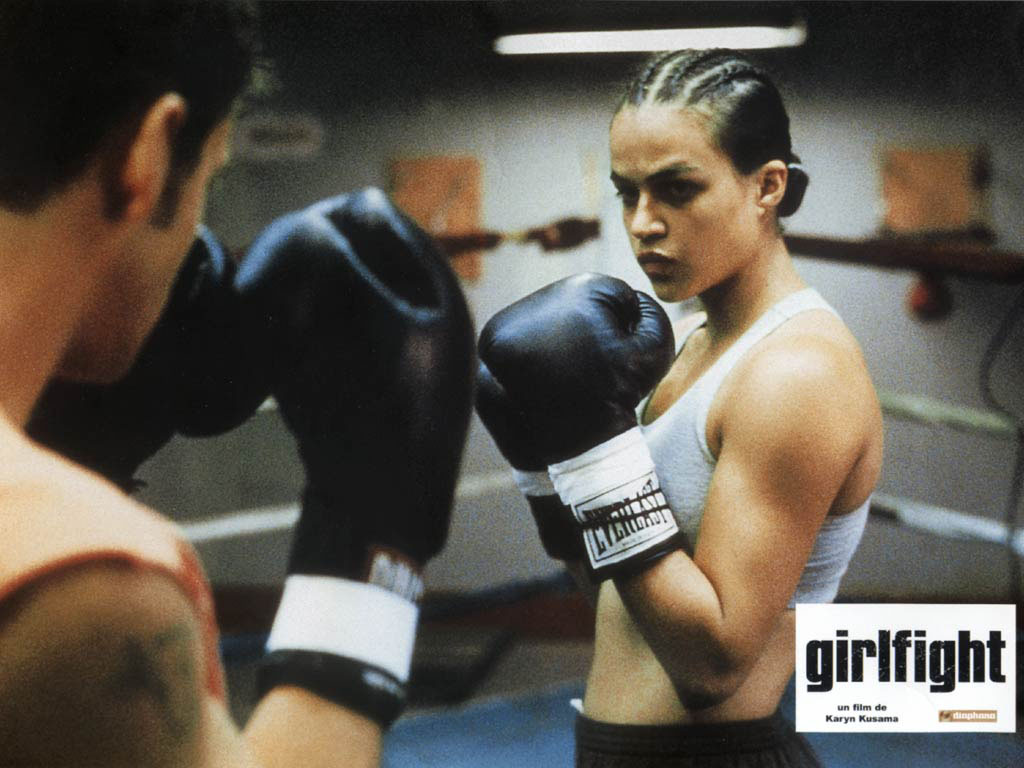
Girlfight's Foxy Boxing: Possibly the Queerest Straight Romance on Film?
Before I go any farther, let me just say that the New York State Boxing Commission has never authorized gender-blind boxing for men and women in the same weight class. That plot point is a bit of fantasy. Mixed boxing matches do happen, sometimes as exhibition matches and then, of course, as a sub-genre within the erotic entertainment format commonly referred to as "foxy boxing." (Foxy boxing normally features two or more women, but is sometimes staged between men and women.)
This counterbalances the opening scene in Girlfight, in which with Guzman beats down one girl to protect another - and a later scene which suggests that the hostility between Guzman and her female nemesis at school is underwritten by some sort of romantic history. Given the character's queerness (her active refusal to be "girlie," her macho attitude and protective relationship with women around her) the climactic boxing match between Guzman and her male lover is just plain fascinating.
All along, Guzman demands to be taken seriously. The lone woman training at her gym, she can't box unless the guys box her. But in sparring matches, guys have a really hard time hitting her - getting around their sense of her weakness, but also around their anxiety about what it would mean to engage her and struggle with her strength. The film suggests as well that such an act - a man hitting a woman - calls to mind familiar scenes of domestic violence. None of the guys want to be that man. (Guzman's mother was a victim of her father's brutality, and her desire to box is explicitly cast in terms of her desire to top her father, and too, to ward off the haunting sense of her powerlessness as a child witness to his rage.) It's impressive that the film makes all of this complexity visible for us, without being didactic.
Kate Sekules writes in The Boxer's Heart that as she was learning to box, this - the hesitation to hit a woman - was as much an issue for her as it was for the men in the film. In an interview with David Templeton, she describes the first time she boxed a woman:
It wasn't easy. It felt...like having to push through glue to hit her. There was this invisible impediment, almost like someone holding down my elbow. I did hit her, eventually, in that first session. I hit her a lot, but I didn't really lay into her. I never got in a really good shot.One of the most complex things about heterosexual dynamics (be in romance or sport) is this "glue" - the sense that there is something between men and women, manifesting itself like a protective surface but which is in fact more like a restrictive bubble. The mindset of course is not limited to how men interact with women - it shapes how women interact with women, and think of themselves, too. When Sekules confronts her inhibitions regarding hitting women, she also confronts her inhibitions regarding her own body in relation to others. In essence, she peels that glue off herself. [See also this article about sparring with a professional woman boxer.]
Back to that boxing scene between Rodriguez's character and the boyfriend: throughout the story, he's struggled with her feelings towards her. She's an atypical Latina, una malcriada, and not the sort of girl who is going to prop up one's sense of masculinity by feigning weakness. So when you see him admire her for her skills, when they bond over the grief and glory of training, you start to see an atypical heterosexual romance in which a guy actually likes the toughness in the girl, and decides it's worth it to sort out what that means for him.
I just can't remember the last film I saw that had a heterosexual romance that looked like this.
That boxing match, as the culmination of both their romance and their training, is a strangely queer moment. She actually wins the fight, and they don't break up. It's crazy, hot, and positively utopian.
Made me think that those foxy boxy people must be onto something....
Friday, October 16, 2009
Paris Foot Gay & Creteil Bebel: Homophobia Extraordinary and Ordinary
I have a couple of thoughts about this interesting story.
1. Paris Foot Gay fields Muslim players, so the impulse to characterize this as a problem between a gay team and a Muslim team is off base, even given the manager's moronic statement. Better to characterize it as a conflict between a gay team, and a homophobic team. Islamophobia is a big part of French culture - supported in part by the representation of Muslims (and Arabs more generally) as backwards women-hating, homophobic fundamentalists. As a gay team with an anti-racist policy (and a multicultural roster), PFG knows this and has been smarter about this issue in its statements than has been the French press (at least as represented by the television broadcasts I could access on youtube).
2. Creteil Bebel has come around, and explained that their objection was less to the fact that PFG is gay, than to the fact that "Gay" is in their name - that they advertise themselves as a political team. Some bloggers are confused by this - in part because it's a load of bull, given the manager's earlier statements. But this is in fact a pretty common reaction to the words "gay" and "lesbian". Just saying them can be a political act. And in the space of football, it is - PFG identifies itself as a gay team in order to both advertise itself as an anti-homophobic team (which gay players may prefer) and also to raise awareness and combat homophobia within the leagues.
3. Somehow the way this story was reported bugged me: Smug media bulletins about this, as if suddenly sports editors care about homophobia - when those very same media outlets ignore an entire sport (women's soccer) because of its own sexism and homophobia. I could be wrong, but I suspect the only reason we are hearing about this is because PFG is an activist team and would have responded to this with a press release. Which is good - it shows you just how much one well-funded, savvy team can accomplish.
Anyway, hooray to PFG for opening up dialogue with a phobic team, and forwarding conversation about the issue within the French leagues. And I'm glad Creteil Bebel changed their minds. Let's hope they have a good game. And sack their manager.
Footnote: Paris Foot Gay is partly sponsored by Agnès B.
Thursday, October 8, 2009
The Damned United: A Review

Dirty, dirty Leeds. Dirty fucking Leeds. After reading David Peace's novel The Damned UTD these words cycled through my head for days. They work as an obsessive refrain in Peace's account of Brian Clough's infamous 44 days as the manager of (dirty, dirty) Leeds.
I knew nothing about Clough, Leeds, and this bizarre story before reading Peace's novel - that I enjoyed the book, and felt as if Clough himself, in all his puerile genius, had wormed his way into my head is as good a testimony as I can give to the intensity and distinctiveness of Peace's writing.
Like any fan of a novel, I reacted to the news that it was being turned into a movie with suspicion. In the movie theater, a couple near me asked if this was a "sports movie, you know, like an underdog story." The answer to this is, No. This is a story about a guy who was an underdog when he took over Derby County and led them from the bottom of the second division to the top of the first in two years. (Imagine!) When Don Revie, manager of Clough's hated Leeds UTD, was promoted to England manager (a job Clough wanted, but never got), Leeds asked Clough to take over the storied side. Which he did, and bungled - he was sacked after 44 days of antagonism and controversy. He was an outsider at this point in his life, sure, but he was already pegged as a football genius.
So, there is no underdog in this story - no glorious win. Just the story of an impudent, self-centered (gifted) bastard so driven by hate that he takes over a team in order to take them apart.
The film is gentler than the book. (A film which stuck to the maniacal tone of Peace's writing would, in fact, be almost unwatchable.) The screenplay splits its time between Clough's Oedipal struggle against Revie, and his friendship with his partner, the coach Peter Taylor (Taylor refused to move to Leeds with him). Their relationship is explicitly cast in terms of love - the film plays with their dynamic as a couple, and this is where any of the tenderness and emotion in the film is expressed.
I loved the film. But I also love English weather and Thomas Hardy novels. It's visually gorgeous, but everything is gray, wet, and dilapidated. If there is paint on the walls, it's peeling. If there is wallpaper, it's greasy. Glass is grimey. Fields are muddy. Ceilings are low and stained. Early on, there is a lovely scene of Clough, desperate to impress, trying to tidy up the facilities at Derby before an early match against Leeds - polishing tarnished brass, scrubbing blacked grout. Even the football is dirty - all I remember about the games in the film is mud, rain, and blood.
Given this, that refrain "dirty, dirty Leeds" takes on an added importance. Everything around Clough feels shabby and worthless when compared to what Revie has. Clough is more boy than man, invested in a recognition (from Revie) that he'll never get (Revie refuses the hand Clough offers him, not in a deliberate slight but because he didn't notice Clough, who was cloaked in insignificance). As we watch Clough trying to scrub away the dirt of a working class world (his world), we see a man who on some level feels he will never be good enough, a man incapable, too, of being happy with what he has. And of course, this restlessness, this discontent was behind the arrogance and ambition that made him such a legend.
[I expanded this review for Pitch Invasion - you can read the revision here.]
Friday, October 2, 2009
'The Golden Age' and 'Goal Dreams': Two Football Documentaries, Two Very Different Pictures
"The Golden Age" is a Queens, NY league of mostly Latino players over 40 - it is also the title of a brilliantly filmed and edited documentary celebrating the global game and its particularly migratory character within the US. The film makers manage to capture the skill and energy of the players who slog out their season in Corona Park/Flushing Meadows, on the grounds of the 1964 Worlds Fair - I have never seen a documentary about the grassroots game that actually captures what it feels like to play and participate in a league like this one. And the documentary fleshes this out with terrific portraits of la cultura futbolística in the countries in which many of these guys grew up (Chile, Paraguay, Colombia). In many ways, the hour-long film is a pure luxury. You can watch it at voces.tv.The film-makers are the first to confess they don't speak Spanish - and this makes me wonder if this isn't in part why the league drama with which the film ends isn't explored in more detail (most of the league's teams walk out of the playoffs, accusing the league organizers of favoritism and corruption). Speaking from my own experience (which includes this linguistic limit), local leagues are tough, dense and complex scenes - we certainly glimpse this in The Golden Age, and it's where the rose colored glasses begin to slip off. This is where tougher stories emerge - these leagues are sights of incredible social stability for people living in increasingly precarious conditions, they are the platforms for consciousness raising and community building, but they are also sites of petty exploitation and steady conflict with, oh, nearly everything one might expect (park officials, property developers, ordinary greed, group dynamics). But these points are made by a viewer who really just wanted more, more, more. [Just learned that the film on voces.tv is a short version of a feature length film - this explains a lot!] It is an achingly beautiful portrait of the grassroots game and the pleasures it offers its players.

Goal Dreams (2006) follows the Palestinian national soccer team as its organizers try to pull a team together for a 2006 World Cup qualifying match against Uzbekistan. There isn't much to romance in this story. Players are pulled from all over the globe (Chile, Kuwait, Sweden, Lebanon, the US). They train in Egypt, where they wait for a dozen players from Gaza who are held up for weeks as they are unable to cross the border. Because movement between the West Bank and Gaza, and between cities on the West Bank is nearly impossible, putting a team together from within Palestine (which, furthermore, had no league at the time) seemed unthinkable.
This is a sobering film of a team with next to no resources - as much as one wants to make an uplifting story out of their plight, you can't. As the film progresses, the enterprise takes on a depressing hopelessness - players show up looking glum and the Austrian coach asks "where's your smile?" The Palestinian players tell the translator that five of their friends were killed in an air strike during the night.
Players talk about the impossibility of playing together on a team where the language barriers are so intense - the Palestinians from outside the region were born and raised in Latin America, Europe, and the U.S. and have no common tongue. Players from Gaza and the West Bank spend weeks in limbo waiting to cross the border while their teammates train without them. There is a cringe worthy sound bite from FIFA chairman Gerome Campagne who explains FIFA's refusal to postpone the match against Uzbekistan with these words: "What is important is [for FIFA] to not be mixed up in political issues." FIFA, furthermore, only postpones matches when there is a "force majeure" - the occupation of Palestine and the nightmare it produces for its citizens is not, in their view, a "force majeure." In the end, after Isreal delayed half the team's departure from Gaza, and then refused to allow exit visas for a number of players, they lost 0-3.
The team's organizers have reconsidered their whole approach. Until very recently, players still couldn't train or play matches in Palestine - and even now, with a home stadium, negotiating travel to this stadium remains an obstacle. But the current roster consists largely of Palestinian players from within the country, and the team - as well as Palestinian football - seems increasingly stable. Or at least more stable than it had been, which isn't saying much.
Subscribe to:
Posts (Atom)


